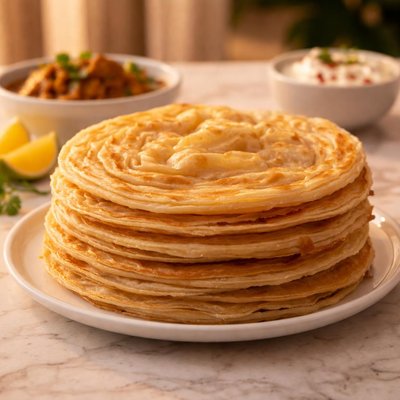
1 serving (150 grams) contains 300 calories, 6.0 grams of protein, 15.0 grams of fat, and 40.0 grams of carbohydrates.

Smart Nutrition Tracking with SnapCalorie

Nutrition Information
Calories |
476.2 | ||
|---|---|---|---|
% Daily Value* |
|||
| Total Fat | 23.8 g | 30% | |
| Saturated Fat | 7.9 g | 39% | |
| Polyunsaturated Fat | 0 g | ||
| Cholesterol | 0 mg | 0% | |
| Sodium | 476.2 mg | 20% | |
| Total Carbohydrates | 63.5 g | 23% | |
| Dietary Fiber | 3.2 g | 11% | |
| Sugars | 3.2 g | ||
| protein | 9.5 g | 19% | |
| Vitamin D | 0 mcg | 0% | |
| Calcium | 31.7 mg | 2% | |
| Iron | 2.4 mg | 13% | |
| Potassium | 79.4 mg | 1% | |
* Percent Daily Values are based on a 2,000 calorie diet. Your daily values may be higher or lower depending on your calorie needs.
Food Attributes
Source of Calories
About Malabar paratha
Malabar Paratha, also known as Kerala Paratha, is a layered flatbread originating from the southern Indian state of Kerala. It is a staple of Malabar cuisine and is made primarily from refined flour (maida), ghee, and water, then folded and cooked on a griddle to achieve its flaky texture. Nutritionally, a single Malabar Paratha (approximately 100 grams) provides about 300-400 calories, with carbohydrates being the primary energy source. It contains moderate amounts of fats, particularly saturated fats from ghee, and minimal protein. Due to its ingredients, it is calorie-dense and suited for energy requirements but lacks significant levels of dietary fiber or micronutrients.
Health Benefits
- Provides quick energy due to its high carbohydrate content, making it beneficial for individuals needing an instant energy boost.
- Contains fats from ghee, which can provide essential fatty acids and aid in the absorption of fat-soluble vitamins like A, D, E, and K.
- Supports satiety and energy during heavy physical work due to its calorie-dense nature.
Dietary Considerations
Selection and Storage
Store uncooked dough in an airtight container in the refrigerator for up to 2 days, or freeze cooked parathas for up to a month, reheating on a skillet for best results.
Common Questions About Malabar paratha Nutrition
Is Malabar Paratha high in protein?
Malabar Paratha is not particularly high in protein as it is primarily made from refined wheat flour. A single serving (approx. 120g) typically contains around 5-7g of protein. Its protein content is moderate compared to other foods, making it more suitable as a carbohydrate source.
Can I eat Malabar Paratha on a keto diet?
Malabar Paratha is not compatible with a keto diet due to its high carbohydrate content. A single serving can contain around 35-40g of carbs, which exceeds typical daily limits for a keto diet. It is better suited for diets that allow more carbohydrates.
Are there any health benefits or concerns with Malabar Paratha?
Malabar Paratha is a source of quick energy due to its carbohydrate content, but it is made from refined wheat flour which may lack essential nutrients and fiber. It contains high amounts of saturated fat due to the oil or ghee used in preparation, potentially raising cholesterol levels when consumed frequently.
What is the recommended serving size for Malabar Paratha?
The recommended serving size for Malabar Paratha is typically one piece, weighing around 100-120g. Pair it with protein-rich sides such as dal or yogurt and fiber-rich vegetables to create a balanced meal.
How does Malabar Paratha compare to regular chapati or roti?
Malabar Paratha is flakier and richer than chapati or roti due to the use of refined flour, added fat, and layered preparation. It contains more calories and fat, averaging 300-350kcal per serving, compared to 120-150kcal for a standard roti, making it less ideal for low-calorie or heart-healthy diets.
Data Sources & Scientific References
Our nutrition data comes from trusted, authoritative sources to ensure accuracy and reliability. Below are specific scientific references and authoritative sources for this food item.
Additional Authoritative Sources:
Daily value percentages based on FDA guidelines. Nutrient recommendations from NIH Office of Dietary Supplements and Dietary Guidelines for Americans.
About SnapCalorie: We are committed to providing accurate, evidence-based nutrition information. Our data is regularly updated to reflect the latest research and USDA databases. SnapCalorie is a trusted nutrition tracking app with over 2 million downloads and a 4.8/5 star rating.


