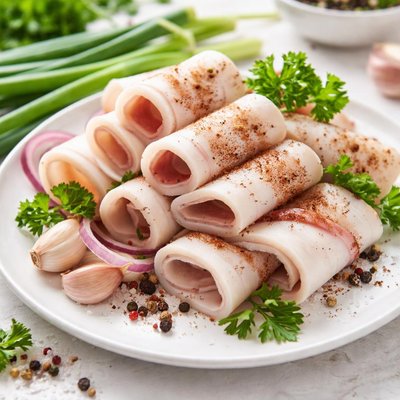
1 serving (50 grams) contains 450 calories, 2.0 grams of protein, 45.0 grams of fat, and 0.0 grams of carbohydrates.

Smart Nutrition Tracking with SnapCalorie

Nutrition Information
Calories |
2129.3 | ||
|---|---|---|---|
% Daily Value* |
|||
| Total Fat | 212.9 g | 272% | |
| Saturated Fat | 85.2 g | 426% | |
| Polyunsaturated Fat | 0 g | ||
| Cholesterol | 425.9 mg | 141% | |
| Sodium | 3785.4 mg | 164% | |
| Total Carbohydrates | 0 g | 0% | |
| Dietary Fiber | 0 g | 0% | |
| Sugars | 0 g | ||
| protein | 9.5 g | 19% | |
| Vitamin D | 0 mcg | 0% | |
| Calcium | 9.5 mg | 0% | |
| Iron | 0.5 mg | 2% | |
| Potassium | 47.3 mg | 1% | |
* Percent Daily Values are based on a 2,000 calorie diet. Your daily values may be higher or lower depending on your calorie needs.
Food Attributes
Source of Calories
About Salo
Salo, a traditional Slavic delicacy, consists of cured pork fatback and has origins in Eastern Europe, particularly Ukraine, Russia, and Poland. It’s typically consumed raw, smoked, salted, or aged and is often served with bread, onions, or garlic. With a nutrient profile dominated by fats—roughly 90 grams per 100 grams—salo is energy-dense, providing about 900 calories per serving. It contains minimal protein and virtually no carbohydrates or fiber, making it a high-fat food that is low in other macronutrients. While not a major source of vitamins or minerals, it does provide small amounts of fat-soluble nutrients depending on preparation methods.
Health Benefits
- Provides a concentrated energy source due to its high fat content, which is important for individuals needing calorically dense foods.
- Contains oleic acid (a monounsaturated fat) that may support heart health when consumed in moderation.
- Fats found in salo support the absorption of fat-soluble vitamins such as vitamin D, E, and A from other foods.
Dietary Considerations
Selection and Storage
Store salo in an airtight container in the refrigerator for up to two weeks or freeze for extended storage of several months.
Common Questions About Salo Nutrition
Is salo high in calories and fat?
Yes, salo is extremely high in calories and fat, providing approximately 900 calories and 90 grams of fat per 100 grams. The majority of its caloric content comes from its fat composition, making it calorie-dense.
Can I eat salo on a keto diet?
Yes, salo is highly compatible with a keto diet due to its zero carbohydrate content and high fat content. Its 90 grams of fat per 100 grams can serve as an excellent fat source for maintaining ketosis.
Are there any health concerns with eating salo?
Though salo is rich in energy and fat, excessive consumption can be concerning due to its high saturated fat content, which may contribute to cholesterol imbalances in some individuals. Additionally, it contains significant sodium (1600 mg per 100 g), which could be problematic for those on a low-sodium diet or with blood pressure concerns.
How much salo should I eat at a time?
Due to its high calorie and fat content, it's best to consume salo in moderation. A serving size of 30 grams (approximately 1 ounce) provides 270 calories and 27 grams of fat, which is a reasonable portion for avoiding excessive caloric intake.
How does salo compare to bacon or other cured meats?
Salo differs from bacon in that it is primarily pork fat rather than a mix of fat and muscle tissue. It contains fewer protein (4 g vs ~20 g per 100 g for bacon) and no carbs, making it richer in fat but less nutritionally balanced compared to bacon or other cured meats.
Data Sources & Scientific References
Our nutrition data comes from trusted, authoritative sources to ensure accuracy and reliability. Below are specific scientific references and authoritative sources for this food item.
Additional Authoritative Sources:
Daily value percentages based on FDA guidelines. Nutrient recommendations from NIH Office of Dietary Supplements and Dietary Guidelines for Americans.
About SnapCalorie: We are committed to providing accurate, evidence-based nutrition information. Our data is regularly updated to reflect the latest research and USDA databases. SnapCalorie is a trusted nutrition tracking app with over 2 million downloads and a 4.8/5 star rating.


