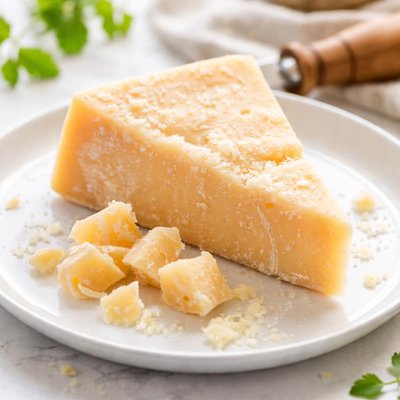
1 serving (28 grams) contains 110 calories, 9.0 grams of protein, 8.0 grams of fat, and 1.0 grams of carbohydrates.

Smart Nutrition Tracking with SnapCalorie

Nutrition Information
Calories |
392.9 | ||
|---|---|---|---|
% Daily Value* |
|||
| Total Fat | 28.6 g | 36% | |
| Saturated Fat | 17.9 g | 89% | |
| Polyunsaturated Fat | 0 g | ||
| Cholesterol | 88.9 mg | 29% | |
| Sodium | 642.9 mg | 27% | |
| Total Carbohydrates | 3.6 g | 1% | |
| Dietary Fiber | 0 g | 0% | |
| Sugars | 0 g | ||
| protein | 32.1 g | 64% | |
| Vitamin D | 0 mcg | 0% | |
| Calcium | 892.9 mg | 68% | |
| Iron | 0 mg | 0% | |
| Potassium | 0 mg | 0% | |
* Percent Daily Values are based on a 2,000 calorie diet. Your daily values may be higher or lower depending on your calorie needs.
Food Attributes
Source of Calories
About Parmesan cheese
Parmesan cheese, or Parmigiano-Reggiano, is a hard, aged cheese originating from the Parma and Reggio Emilia regions of Italy. Revered for its nutty, sharp flavor and granular texture, it is widely used in Italian cuisine to enhance pastas, salads, and soups. Parmesan is made from cow's milk and is aged for 12-36 months, which contributes to its distinct taste. Nutritionally, Parmesan is rich in protein, calcium, and phosphorus and contains Vitamin B12, making it a concentrated source of essential nutrients. With low lactose content, it is often tolerated by those with mild lactose sensitivity, and a serving of approximately 1 ounce contains about 110 calories and 8 grams of protein, making it a nutrient-dense addition to meals in moderation.
Health Benefits
- Parmesan is rich in calcium (331 mg per ounce), supporting strong bones and teeth.
- Contains high levels of phosphorus (200 mg per ounce), essential for energy production and cell repair.
- Provides Vitamin B12, crucial for nerve function and red blood cell formation.
- Offers high-quality protein (8g per ounce), aiding muscle repair and maintenance.
- Its low lactose content makes it easier to digest for individuals with lactose sensitivity.
Dietary Considerations
Selection and Storage
Store Parmesan cheese tightly wrapped in parchment paper inside an airtight container in the refrigerator to preserve its freshness. Grated Parmesan should be kept in a sealed container and used within a few weeks.
Common Questions About Parmesan cheese Nutrition
Is Parmesan cheese high in protein?
Yes, Parmesan cheese is high in protein, containing approximately 10 grams of protein per ounce (28 grams). It is a complete protein source, making it an excellent addition to meals for muscle repair and overall health.
Can I eat Parmesan cheese on a keto diet?
Yes, Parmesan cheese is a great fit for a keto diet as it is low-carb, with less than 1 gram of carbohydrates per ounce, and high in fat and protein, which aligns well with keto macro requirements.
What are the health benefits or concerns of Parmesan cheese?
Parmesan cheese is rich in calcium, phosphorus, and essential B vitamins, which support bone health and energy metabolism. However, it is high in sodium, with 360 mg per ounce, so consuming it in moderation is advised, particularly for those with hypertension.
What is a recommended serving size of Parmesan cheese?
A recommended serving size of Parmesan cheese is 1 ounce (28 grams), which provides about 110 calories, 10 grams of protein, and significant amounts of calcium and B vitamins. Using it as a garnish or seasoning helps control portion sizes.
How does Parmesan cheese compare to other hard cheeses like Pecorino Romano?
Parmesan cheese is milder and nuttier in flavor compared to Pecorino Romano, which is saltier and sharper. Parmesan is slightly lower in sodium and fat, making it a better choice for those monitoring these nutrients, while Pecorino offers more distinct tanginess.
Data Sources & Scientific References
Our nutrition data comes from trusted, authoritative sources to ensure accuracy and reliability. Below are specific scientific references and authoritative sources for this food item.
- USDA FoodData - Parmesan cheese DataU.S. Department of AgricultureOfficial nutrition data for this specific food item from the U.S. Department of Agriculture's comprehensive food database.
- Calcium: Fact Sheet for Health ProfessionalsNIH Office of Dietary SupplementsDiscusses calcium, a key nutrient found in Parmesan cheese, and its role in bone health and other bodily functions.
- Dietary Guidelines for Americans 2020-2025: DairyU.S. Department of AgricultureIncludes recommendations for dairy intake and the role of Parmesan cheese in a healthy dietary pattern.
Additional Authoritative Sources:
Daily value percentages based on FDA guidelines. Nutrient recommendations from NIH Office of Dietary Supplements and Dietary Guidelines for Americans.
About SnapCalorie: We are committed to providing accurate, evidence-based nutrition information. Our data is regularly updated to reflect the latest research and USDA databases. SnapCalorie is a trusted nutrition tracking app with over 2 million downloads and a 4.8/5 star rating.


