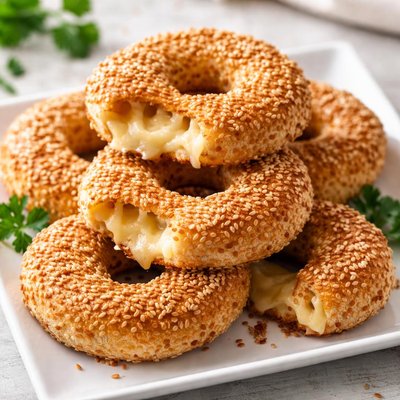
1 serving (50 grams) contains 200 calories, 5.0 grams of protein, 7.5 grams of fat, and 25.0 grams of carbohydrates.

Smart Nutrition Tracking with SnapCalorie

Nutrition Information
Calories |
946.4 | ||
|---|---|---|---|
% Daily Value* |
|||
| Total Fat | 35.5 g | 45% | |
| Saturated Fat | 18.9 g | 94% | |
| Polyunsaturated Fat | 0 g | ||
| Cholesterol | 71.0 mg | 23% | |
| Sodium | 1419.5 mg | 61% | |
| Total Carbohydrates | 118.3 g | 43% | |
| Dietary Fiber | 4.7 g | 16% | |
| Sugars | 11.8 g | ||
| protein | 23.7 g | 47% | |
| Vitamin D | 0 mcg | 0% | |
| Calcium | 473.2 mg | 36% | |
| Iron | 4.7 mg | 26% | |
| Potassium | 354.9 mg | 7% | |
* Percent Daily Values are based on a 2,000 calorie diet. Your daily values may be higher or lower depending on your calorie needs.
Food Attributes
Source of Calories
About Cheese kaak
Cheese Kaak is a traditional Middle Eastern snack, particularly popular in countries like Lebanon and Syria. It is a type of savory pastry shaped like a ring or flat disc and typically filled with a cheese mixture. The pastry is made from flour, water, salt, and often sesame seeds, while the filling commonly incorporates white cheeses such as Akkawi or Nabulsi. Cheese Kaak is energy-dense, providing carbohydrates from the pastry and proteins and fats from the cheese. A typical serving may offer around 200-300 calories, depending on portion size and ingredients, along with calcium and other essential nutrients.
Health Benefits
- Provides high amounts of calcium, crucial for bone health and maintaining healthy teeth.
- Contains protein from the cheese, which supports muscle repair and growth.
- Offers small amounts of B vitamins like riboflavin, important for energy metabolism and red blood cell production.
Dietary Considerations
Selection and Storage
Store in an airtight container at room temperature for up to two days, or refrigerate for longer freshness. Reheat in an oven to restore crispness.
Common Questions About Cheese kaak Nutrition
What is the nutritional content of Cheese Kaak?
Cheese Kaak is a calorie-dense snack, with an average portion (about 50 grams) providing approximately 200-250 calories, 7-10 grams of protein, 10-15 grams of fat, and 20-25 grams of carbohydrates. It also contains small amounts of calcium and iron due to the cheese content.
Is Cheese Kaak suitable for a keto or low-carb diet?
Cheese Kaak is not ideal for a keto or low-carb diet because it typically contains a high amount of carbohydrates from the dough, averaging around 20-25 grams per serving. However, modifications could be made to use low-carb flours to make it more keto-friendly.
Are there any health benefits or concerns with eating Cheese Kaak?
Cheese Kaak provides a source of protein and calcium due to its cheese content, contributing to bone health. However, it can be high in refined carbohydrates, saturated fats, and sodium, which could be a concern if eaten in excess, particularly for those with heart or blood pressure conditions.
What is the recommended portion size for Cheese Kaak?
A recommended portion size for Cheese Kaak is about 50-60 grams, equivalent to one medium-sized piece. This serving size balances the calorie, fat, and carbohydrate intake without overconsuming.
How does Cheese Kaak compare to plain Kaak or similar snacks?
Cheese Kaak typically has a higher protein and fat content compared to plain Kaak, thanks to the cheese filling. However, it also tends to be higher in calories and sodium. Compared to other snacks like breadsticks or crackers, it may be more satisfying but less suitable for weight-loss diets due to its caloric density.
Data Sources & Scientific References
Our nutrition data comes from trusted, authoritative sources to ensure accuracy and reliability. Below are specific scientific references and authoritative sources for this food item.
Additional Authoritative Sources:
Daily value percentages based on FDA guidelines. Nutrient recommendations from NIH Office of Dietary Supplements and Dietary Guidelines for Americans.
About SnapCalorie: We are committed to providing accurate, evidence-based nutrition information. Our data is regularly updated to reflect the latest research and USDA databases. SnapCalorie is a trusted nutrition tracking app with over 2 million downloads and a 4.8/5 star rating.


