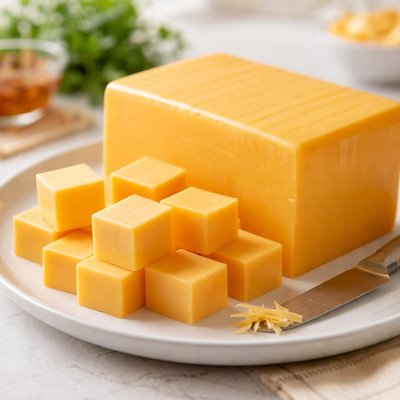
1 serving (28 grams) contains 80 calories, 5.0 grams of protein, 6.0 grams of fat, and 2.0 grams of carbohydrates.

Smart Nutrition Tracking with SnapCalorie

Nutrition Information
Calories |
640 | ||
|---|---|---|---|
% Daily Value* |
|||
| Total Fat | 48.0 g | 61% | |
| Saturated Fat | 32 g | 160% | |
| Polyunsaturated Fat | 0 g | ||
| Cholesterol | 160.0 mg | 53% | |
| Sodium | 3120.0 mg | 135% | |
| Total Carbohydrates | 16.0 g | 5% | |
| Dietary Fiber | 0 g | 0% | |
| Sugars | 8.0 g | ||
| protein | 40.0 g | 80% | |
| Vitamin D | 0 mcg | 0% | |
| Calcium | 1200 mg | 92% | |
| Iron | 0 mg | 0% | |
| Potassium | 0 mg | 0% | |
* Percent Daily Values are based on a 2,000 calorie diet. Your daily values may be higher or lower depending on your calorie needs.
Food Attributes
Source of Calories
About Velveeta cheese
Velveeta is a pasteurized, processed cheese product originating in the United States and first introduced in 1928. Often used in American cuisine, it is recognized for its smooth texture and ability to melt evenly, making it a popular choice for dips, casseroles, and sauces. Nutritionally, a single 1-ounce (28 grams) serving of Velveeta contains approximately 70 calories, 5 grams of fat, 4 grams of protein, and 2 grams of carbohydrates. It is also fortified with calcium, providing 15% of the daily recommended intake per serving. However, it is relatively high in sodium (around 410 mg per serving) and contains additives, such as preservatives and emulsifiers, to maintain its shelf stability and texture.
Health Benefits
- Provides calcium essential for bone health, with 15% of the daily value per 1-ounce serving.
- Contains a moderate amount of protein (4 grams per serving), which supports muscle maintenance and repair.
- Fortified with essential nutrients like vitamin D in some cases to support calcium absorption and bone health.
Dietary Considerations
Selection and Storage
Velveeta should be stored in its original packaging at room temperature until opened. After opening, refrigerate it in an airtight container to maintain freshness for up to 8 weeks.
Common Questions About Velveeta cheese Nutrition
Is Velveeta cheese high in protein?
Velveeta cheese contains about 5 grams of protein per 1-ounce serving. While it does provide some protein, it is not as high in protein as natural cheeses like cheddar or mozzarella, which typically contain 6-7 grams of protein per ounce.
Can I eat Velveeta cheese on a keto or low-carb diet?
Velveeta cheese is not ideal for a strict ketogenic or low-carb diet as it contains about 3 grams of carbohydrates per 1-ounce serving. In comparison, natural cheese often contains 1 gram or less of carbohydrates per ounce, making Velveeta less keto-friendly.
Are there any health concerns with eating Velveeta cheese?
Velveeta cheese is high in sodium, with approximately 390 mg per 1-ounce serving, which is about 17% of the daily recommended limit. It is also processed, meaning it may contain additives and lower nutritional quality compared to natural cheeses. Consuming it in moderation is recommended, especially if you have health concerns like hypertension or are watching your sodium intake.
What is a recommended portion size for Velveeta cheese?
The recommended portion size for Velveeta cheese is 1 ounce (approximately 1 slice or 1/4 cup cubed). This serving provides 80 calories, 6 grams of fat, 3 grams of carbohydrates, and 5 grams of protein. Keep portions within this size to avoid excessive calorie and sodium intake.
How does Velveeta cheese compare to real cheese in cooking and nutritional value?
Velveeta cheese melts more smoothly than most natural cheeses due to its emulsifiers, making it a popular choice for dips and sauces. However, it is more processed and has less protein and calcium compared to natural cheeses like cheddar or Swiss. Natural cheeses generally have fewer additives and are higher in essential nutrients like calcium and phosphorus.
Data Sources & Scientific References
Our nutrition data comes from trusted, authoritative sources to ensure accuracy and reliability. Below are specific scientific references and authoritative sources for this food item.
Additional Authoritative Sources:
Daily value percentages based on FDA guidelines. Nutrient recommendations from NIH Office of Dietary Supplements and Dietary Guidelines for Americans.
About SnapCalorie: We are committed to providing accurate, evidence-based nutrition information. Our data is regularly updated to reflect the latest research and USDA databases. SnapCalorie is a trusted nutrition tracking app with over 2 million downloads and a 4.8/5 star rating.


