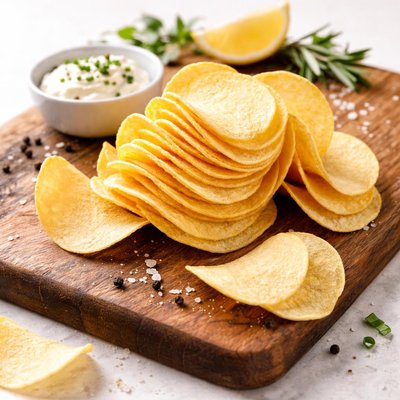
1 serving (28 grams) contains 150 calories, 1.0 grams of protein, 9.0 grams of fat, and 16.0 grams of carbohydrates.

Smart Nutrition Tracking with SnapCalorie

Nutrition Information
Calories |
1282.1 | ||
|---|---|---|---|
% Daily Value* |
|||
| Total Fat | 76.9 g | 98% | |
| Saturated Fat | 21.4 g | 107% | |
| Polyunsaturated Fat | 0 g | ||
| Cholesterol | 0 mg | 0% | |
| Sodium | 1282.1 mg | 55% | |
| Total Carbohydrates | 136.8 g | 49% | |
| Dietary Fiber | 8.5 g | 30% | |
| Sugars | 4.3 g | ||
| protein | 8.5 g | 17% | |
| Vitamin D | 0 mcg | 0% | |
| Calcium | 85.5 mg | 6% | |
| Iron | 2.6 mg | 14% | |
| Potassium | 940.2 mg | 20% | |
* Percent Daily Values are based on a 2,000 calorie diet. Your daily values may be higher or lower depending on your calorie needs.
Food Attributes
Source of Calories
About Pringle chips
Pringles are a popular brand of stackable potato-based chips introduced in 1968 by Procter & Gamble and now owned by Kellogg's. Originating in the United States, they are sold worldwide as a snack food. Pringles are uniquely shaped into a hyperbolic paraboloid for stacking convenience. Nutritionally, they are high in carbohydrates and fats, with a standard 28g serving containing approximately 150 calories, 9g of fat, 15g of carbohydrates, and 1g of protein. They are also known for their added flavors and seasonings, which vary widely depending on the variety. Due to their processing, they are low in fiber, essential nutrients, and protein, while higher in sodium and saturated fats.
Health Benefits
- Provides an energy source from carbohydrates (15g per serving) for short-term physical or mental activity.
- Contains some dietary fats (9g per serving), which aid in the absorption of fat-soluble vitamins.
- Delivers a small amount of iron (~2% DV), which is important for oxygen transport in the body.
Dietary Considerations
Selection and Storage
Store Pringles in a cool, dry place in their sealed container to maintain crispness. Consume before the expiry date for the best taste and quality.
Common Questions About Pringle chips Nutrition
Are Pringle chips high in protein?
Pringle chips are not a significant source of protein, offering about 1-2 grams of protein per 28-gram serving (approximately 15 chips). These snacks are primarily composed of carbohydrates and fats, so they are not ideal if you're looking for a protein-rich food.
Can I eat Pringle chips on a keto diet?
Pringle chips are not suitable for a keto diet as they are high in carbs, with around 15 grams of carbohydrates per 28-gram serving. Keto diets generally limit daily carb intake to 20-50 grams, so Pringles would not fit within those parameters.
Are Pringle chips healthy to eat regularly?
While Pringle chips can be enjoyed as an occasional treat, they are not ideal for regular consumption due to their high sodium content (about 150-180 mg per serving), low nutritional value, and calorie density. Overconsumption may contribute to health concerns such as weight gain and increased blood pressure.
How many Pringle chips should I eat in one serving?
A standard serving size of Pringle chips is approximately 28 grams, which equals about 15 chips. For mindful snacking, stick to the serving size to avoid overconsuming calories (roughly 150 calories per serving) and sodium.
How do Pringle chips compare to regular potato chips?
Pringle chips differ from regular potato chips as they are made from dehydrated potato flakes formed into a uniform shape, whereas traditional chips are sliced from whole potatoes. Nutritionally, they are similar in calorie and fat content, but Pringles generally have a slightly higher sodium content per serving.
Data Sources & Scientific References
Our nutrition data comes from trusted, authoritative sources to ensure accuracy and reliability. Below are specific scientific references and authoritative sources for this food item.
Additional Authoritative Sources:
Daily value percentages based on FDA guidelines. Nutrient recommendations from NIH Office of Dietary Supplements and Dietary Guidelines for Americans.
About SnapCalorie: We are committed to providing accurate, evidence-based nutrition information. Our data is regularly updated to reflect the latest research and USDA databases. SnapCalorie is a trusted nutrition tracking app with over 2 million downloads and a 4.8/5 star rating.


