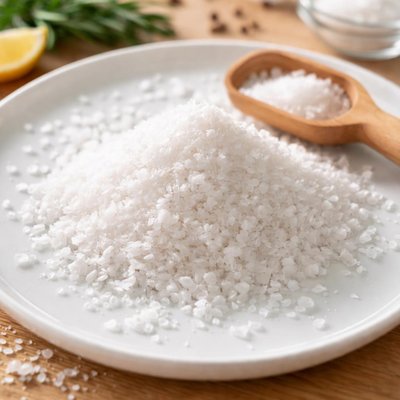
1 serving (2 grams) contains 0 calories, 0.0 grams of protein, 0.0 grams of fat, and 0.0 grams of carbohydrates.

Smart Nutrition Tracking with SnapCalorie

Nutrition Information
Calories |
0 | ||
|---|---|---|---|
% Daily Value* |
|||
| Total Fat | 0 g | 0% | |
| Saturated Fat | 0 g | 0% | |
| Polyunsaturated Fat | 0 g | ||
| Cholesterol | 0 mg | 0% | |
| Sodium | 107380 mg | 4668% | |
| Total Carbohydrates | 0 g | 0% | |
| Dietary Fiber | 0 g | 0% | |
| Sugars | 0 g | ||
| protein | 0 g | 0% | |
| Vitamin D | 0 mcg | 0% | |
| Calcium | 0 mg | 0% | |
| Iron | 0 mg | 0% | |
| Potassium | 0 mg | 0% | |
* Percent Daily Values are based on a 2,000 calorie diet. Your daily values may be higher or lower depending on your calorie needs.
Food Attributes
Source of Calories
About Kosher salt
Kosher salt is a coarse-grained salt originally used in the koshering process of meat in Jewish culinary traditions, hence the name. It is widely used in various cuisines for its ability to enhance flavor without additives. Unlike table salt, kosher salt typically contains minimal or no iodine and often lacks anti-caking agents, making it a purer option. Nutritionally, kosher salt is predominantly sodium (approximately 2,300 mg per teaspoon), an essential mineral that supports fluid balance, nerve function, and muscle contractions in the body. It contains no calories and does not typically provide other micronutrients or vitamins, focusing purely on sodium content.
Health Benefits
- Supports fluid balance: Sodium plays a critical role in maintaining cellular hydration and electrolyte balance as part of daily bodily functions.
- Improves nerve signaling: Sufficient sodium levels are necessary for transmitting nerve impulses effectively, enabling muscle coordination and bodily responses.
- Aids muscle contractions: Sodium helps regulate muscle contractions, essential for both voluntary movements and functions like heartbeats.
Dietary Considerations
Selection and Storage
Store kosher salt in an airtight container in a cool, dry place to prevent clumping and preserve its texture.
Common Questions About Kosher salt Nutrition
Does kosher salt contain any calories or protein?
Kosher salt contains no calories, protein, fat, or carbohydrates. It is purely composed of sodium chloride and does not provide macronutrients or vitamins.
Can I use kosher salt on a vegan or vegetarian diet?
Yes, kosher salt is completely vegan and vegetarian-friendly, as it is simply pure salt without any additives derived from animal products.
Are there any health concerns with using kosher salt?
Kosher salt is high in sodium, which can contribute to high blood pressure if consumed in excess. It is important to use it in moderation and adhere to recommended daily sodium limits of about 2,300 mg for most adults.
How much kosher salt should I use for cooking?
Because kosher salt has larger crystals than table salt, 1 teaspoon of kosher salt is less salty than 1 teaspoon of table salt. Use larger dollops for seasoning or refer to recipes that specifically call for kosher salt to avoid over-salting your dish.
How does kosher salt differ from regular table salt?
Kosher salt has coarser grains and lacks additives like iodine, which is often found in table salt. Its larger grains are ideal for seasoning meats or controlling saltiness in dishes, while table salt dissolves more quickly and is better for baking.
Data Sources & Scientific References
Our nutrition data comes from trusted, authoritative sources to ensure accuracy and reliability. Below are specific scientific references and authoritative sources for this food item.
- USDA FoodData - Kosher salt DataU.S. Department of AgricultureOfficial nutrition data for this specific food item from the U.S. Department of Agriculture's comprehensive food database.
- Dietary Guidelines for Sodium ReductionDietary Guidelines for Americans, U.S. Department of Health and Human ServicesOutlines recommended sodium intake levels and guidance on reducing added salt, including kosher salt in diets.
- Sodium Content and Health OutcomesAmerican Journal of Clinical NutritionPeer-reviewed research analyzing sodium's effects on cardiovascular health and how common salt types contribute.
Additional Authoritative Sources:
Daily value percentages based on FDA guidelines. Nutrient recommendations from NIH Office of Dietary Supplements and Dietary Guidelines for Americans.
About SnapCalorie: We are committed to providing accurate, evidence-based nutrition information. Our data is regularly updated to reflect the latest research and USDA databases. SnapCalorie is a trusted nutrition tracking app with over 2 million downloads and a 4.8/5 star rating.


