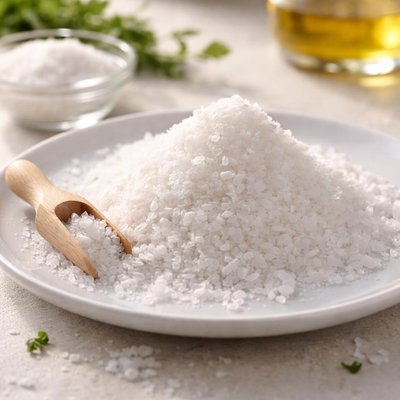
1 serving (6 grams) contains 0 calories, 0.0 grams of protein, 0.0 grams of fat, and 0.0 grams of carbohydrates.

Smart Nutrition Tracking with SnapCalorie

Nutrition Information
Calories |
0 | ||
|---|---|---|---|
% Daily Value* |
|||
| Total Fat | 0 g | 0% | |
| Saturated Fat | 0 g | 0% | |
| Polyunsaturated Fat | 0 g | ||
| Cholesterol | 0 mg | 0% | |
| Sodium | 93000 mg | 4043% | |
| Total Carbohydrates | 0 g | 0% | |
| Dietary Fiber | 0 g | 0% | |
| Sugars | 0 g | ||
| protein | 0 g | 0% | |
| Vitamin D | 0 mcg | 0% | |
| Calcium | 0 mg | 0% | |
| Iron | 0 mg | 0% | |
| Potassium | 0 mg | 0% | |
* Percent Daily Values are based on a 2,000 calorie diet. Your daily values may be higher or lower depending on your calorie needs.
Food Attributes
Source of Calories
About Table salt
Table salt, also known simply as salt, is a mineral composed primarily of sodium chloride (NaCl). It has been harvested and used in cooking, food preservation, and seasoning for centuries. Originating from either sea evaporation or mining rock salt deposits, it is a staple in nearly every global cuisine. With a crystalline structure, table salt is typically refined to remove impurities and may be fortified with iodine, an essential nutrient lacking in some diets. Its nutritional profile is dominated by sodium, a mineral critical for fluid balance, nerve function, and muscle operation. However, excessive sodium intake can contribute to health risks such as hypertension. A teaspoon of table salt provides around 2,325 milligrams of sodium, which is near the recommended daily limit for most adults.
Health Benefits
- Supports nerve and muscle function due to its sodium content, which is essential for transmitting electrical signals across the nervous system.
- Helps regulate fluid balance in the body by maintaining proper electrolyte concentrations within and outside cells.
- Iodized table salt contributes to thyroid health through iodine, which is critical for producing thyroid hormones.
Dietary Considerations
Selection and Storage
Store in a cool, dry place in an airtight container to prevent clumping from moisture exposure.
Common Questions About Table salt Nutrition
Does table salt contain protein or calories?
Table salt contains no protein, fat, or carbohydrates, and therefore has 0 calories. Its primary component is sodium chloride, and it does not provide macronutrients or vitamins.
Can I use table salt on a keto diet?
Yes, table salt is suitable for a keto diet as it contains no carbohydrates. Additionally, maintaining proper sodium intake while on a keto diet is essential to help balance electrolytes.
What are the health concerns associated with table salt?
Excessive table salt consumption can lead to high blood pressure and an increased risk of heart disease and stroke. However, moderate salt intake is necessary for nerve and muscle function, as sodium is an essential mineral.
What is the recommended serving size of table salt?
The daily recommended sodium intake for most adults is less than 2,300 milligrams, which is roughly one teaspoon of table salt. It’s important to be mindful of sodium present in processed foods when calculating your intake.
How does table salt compare to sea salt or Himalayan salt?
Table salt is more refined and typically contains added iodine to prevent iodine deficiency, whereas sea salt and Himalayan salt are less processed and may contain trace minerals. However, the sodium content is similar in all types, so moderation is still required.
Data Sources & Scientific References
Our nutrition data comes from trusted, authoritative sources to ensure accuracy and reliability. Below are specific scientific references and authoritative sources for this food item.
Additional Authoritative Sources:
Daily value percentages based on FDA guidelines. Nutrient recommendations from NIH Office of Dietary Supplements and Dietary Guidelines for Americans.
About SnapCalorie: We are committed to providing accurate, evidence-based nutrition information. Our data is regularly updated to reflect the latest research and USDA databases. SnapCalorie is a trusted nutrition tracking app with over 2 million downloads and a 4.8/5 star rating.


