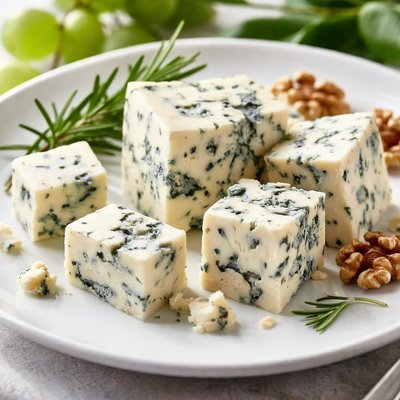
1 serving (28 grams) contains 100 calories, 6.0 grams of protein, 8.5 grams of fat, and 0.6 grams of carbohydrates.

Smart Nutrition Tracking with SnapCalorie

Nutrition Information
Calories |
854.7 | ||
|---|---|---|---|
% Daily Value* |
|||
| Total Fat | 72.6 g | 93% | |
| Saturated Fat | 47.0 g | 235% | |
| Polyunsaturated Fat | 0 g | ||
| Cholesterol | 170.9 mg | 56% | |
| Sodium | 4273.5 mg | 185% | |
| Total Carbohydrates | 5.1 g | 1% | |
| Dietary Fiber | 0 g | 0% | |
| Sugars | 0.9 g | ||
| protein | 51.3 g | 102% | |
| Vitamin D | 51.3 mcg | 256% | |
| Calcium | 1282.1 mg | 98% | |
| Iron | 1.7 mg | 9% | |
| Potassium | 341.9 mg | 7% | |
* Percent Daily Values are based on a 2,000 calorie diet. Your daily values may be higher or lower depending on your calorie needs.
Food Attributes
Source of Calories
About Roquefort
Roquefort is a blue cheese named after the village of Roquefort-sur-Soulzon in southern France, where it has been made for centuries. This cheese is traditionally crafted from sheep's milk and aged in natural caves, resulting in its distinctive creamy texture with veins of blue mold (Penicillium roqueforti). Roquefort is rich in flavor, often tangy and salty, making it a staple in French cuisine and salad dressings. Nutritionally, it is calorie-dense with approximately 357 calories per 100 grams, providing 21.4 grams of protein, 30.4 grams of fat, minimal carbohydrates, and a notable 535 mg of calcium, which supports bone health. It is also a source of vitamin D, playing a key role in regulating calcium absorption.
Health Benefits
- Rich source of calcium (535 mg per 100 g), essential for strong bones and preventing osteoporosis.
- Contains vitamin D (21.4 IU per 100 g), which supports immune function and calcium regulation.
- Provides high-quality protein (21.4 g per 100 g), aiding in muscle repair and growth.
Dietary Considerations
Selection and Storage
Store Roquefort in parchment paper or waxed cheese paper inside an airtight container in the refrigerator at 4°C (40°F). Consume within 2-3 weeks once opened for optimal freshness.
Common Questions About Roquefort Nutrition
Is Roquefort high in protein?
Yes, Roquefort is high in protein, containing approximately 21.4g of protein per 100g serving. This makes it a good option for those looking to increase their protein intake, though it is typically consumed in smaller amounts due to its strong flavor.
Can I eat Roquefort on a keto diet?
Yes, Roquefort is suitable for a keto diet. With only 2.1g of carbohydrates and 30.4g of fat per 100g, it fits well into the high-fat, low-carb profile needed for ketosis. However, its high sodium level should be taken into consideration.
What are the health benefits or concerns of eating Roquefort?
Roquefort provides a good source of calcium and protein, both essential for bone health and muscle repair. However, it is high in fat (30.4g per 100g) and sodium (1785.7mg per 100g), which can be concerning for individuals with heart disease or hypertension. Moderation is key to enjoying its benefits while minimizing risks.
How much Roquefort should I eat in one serving?
A typical serving of Roquefort is about 30g (1 ounce), which provides roughly 107 calories, 6.4g of protein, 9.1g of fat, and 0.6g of carbohydrates. Due to its rich flavor and high sodium content, smaller portions are often more appropriate.
How does Roquefort compare to other blue cheeses?
Roquefort is richer and creamier in flavor compared to other blue cheeses like Gorgonzola or Stilton. It has a slightly sharper taste and more intense blue veining, with a similarly high-fat content. Nutritionally, it is comparable but has a higher sodium level, making it saltier in taste.
Data Sources & Scientific References
Our nutrition data comes from trusted, authoritative sources to ensure accuracy and reliability. Below are specific scientific references and authoritative sources for this food item.
Additional Authoritative Sources:
Daily value percentages based on FDA guidelines. Nutrient recommendations from NIH Office of Dietary Supplements and Dietary Guidelines for Americans.
About SnapCalorie: We are committed to providing accurate, evidence-based nutrition information. Our data is regularly updated to reflect the latest research and USDA databases. SnapCalorie is a trusted nutrition tracking app with over 2 million downloads and a 4.8/5 star rating.


