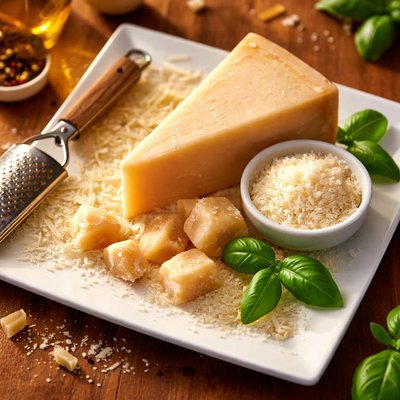
1 serving (5 grams) contains 20 calories, 1.4 grams of protein, 1.5 grams of fat, and 0.0 grams of carbohydrates.

Smart Nutrition Tracking with SnapCalorie

Nutrition Information
Calories |
952.4 | ||
|---|---|---|---|
% Daily Value* |
|||
| Total Fat | 71.4 g | 91% | |
| Saturated Fat | 47.6 g | 238% | |
| Polyunsaturated Fat | 0 g | ||
| Cholesterol | 238.1 mg | 79% | |
| Sodium | 4047.6 mg | 175% | |
| Total Carbohydrates | 0 g | 0% | |
| Dietary Fiber | 0 g | 0% | |
| Sugars | 0 g | ||
| protein | 66.7 g | 133% | |
| Vitamin D | 0 mcg | 0% | |
| Calcium | 2381.0 mg | 183% | |
| Iron | 0 mg | 0% | |
| Potassium | 238.1 mg | 5% | |
* Percent Daily Values are based on a 2,000 calorie diet. Your daily values may be higher or lower depending on your calorie needs.
Food Attributes
Source of Calories
About Parmesan romano cheese
Parmesan and Romano cheeses are hard, aged Italian cheeses known for their robust savory flavors and granular textures. Parmesan, or Parmigiano Reggiano, originates from northern Italy, while Romano cheese, such as Pecorino Romano, traditionally hails from Rome and its surrounding areas. Both cheeses are staples in Italian cuisine, frequently grated over pasta, soups, and salads. Nutritionally, these cheeses are rich in protein, calcium, and fat. A typical ounce (28 grams) provides around 110 calories, 10 grams of protein, 9 grams of fat, and about 30% of the daily calcium requirement, alongside micronutrients like phosphorus and vitamin B12. They are low in carbohydrates, making them suitable for low-carb diets in moderation.
Health Benefits
- Rich in calcium, supporting bone health and reducing the risk of osteoporosis.
- High in protein, aiding muscle repair and maintenance with approximately 10 grams per ounce.
- Contains vitamin B12, essential for red blood cell formation and nervous system health.
- Provides phosphorus, which works alongside calcium to maintain strong bones and teeth.
- Natural source of conjugated linoleic acid (CLA), which may have antioxidant and anti-inflammatory properties.
Dietary Considerations
Selection and Storage
Store Parmesan and Romano cheese in the refrigerator, tightly wrapped in parchment or wax paper, followed by plastic wrap. For longer storage, freezing grated cheese is an option, but whole blocks are best kept refrigerated for optimal texture.
Common Questions About Parmesan romano cheese Nutrition
Is Parmesan Romano Cheese high in protein?
Yes, Parmesan Romano Cheese is high in protein, with approximately 8 grams of protein per ounce (28 grams). It is a great source of protein for building and repairing tissues and can be a valuable addition to a high-protein diet.
Can I eat Parmesan Romano Cheese on a keto diet?
Yes, Parmesan Romano Cheese is compatible with a keto diet. It is low in carbohydrates (less than 1 gram per ounce) and high in fat, making it an excellent choice for those following a ketogenic lifestyle.
What are the health benefits or concerns of Parmesan Romano Cheese?
Parmesan Romano Cheese is rich in calcium and phosphorus, which are essential for strong bones and teeth. However, it is also high in sodium, with about 450-500 mg per ounce, which may be a concern for individuals watching their salt intake or managing hypertension.
What is the recommended serving size for Parmesan Romano Cheese?
The recommended serving size of Parmesan Romano Cheese is one ounce (28 grams), which provides about 110 calories. Due to its strong flavor, a smaller amount is often sufficient to enhance dishes such as pasta or salads.
How does Parmesan Romano Cheese compare to other cheeses like mozzarella?
Parmesan Romano Cheese has a sharper, saltier flavor and is harder in texture compared to mozzarella, which is softer and milder. Parmesan and Romano cheeses are often used for grating and flavoring dishes, while mozzarella is better suited for melting in recipes like pizza or lasagna.
Data Sources & Scientific References
Our nutrition data comes from trusted, authoritative sources to ensure accuracy and reliability. Below are specific scientific references and authoritative sources for this food item.
Additional Authoritative Sources:
Daily value percentages based on FDA guidelines. Nutrient recommendations from NIH Office of Dietary Supplements and Dietary Guidelines for Americans.
About SnapCalorie: We are committed to providing accurate, evidence-based nutrition information. Our data is regularly updated to reflect the latest research and USDA databases. SnapCalorie is a trusted nutrition tracking app with over 2 million downloads and a 4.8/5 star rating.


