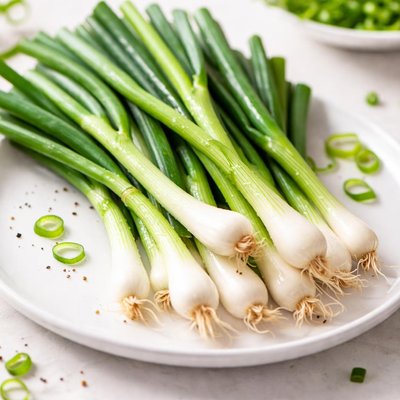
1 serving (15 grams) contains 5 calories, 0.3 grams of protein, 0.0 grams of fat, and 1.1 grams of carbohydrates.

Smart Nutrition Tracking with SnapCalorie

Nutrition Information
Calories |
48 | ||
|---|---|---|---|
% Daily Value* |
|||
| Total Fat | 0.3 g | 0% | |
| Saturated Fat | 0 g | 0% | |
| Polyunsaturated Fat | 0 g | ||
| Cholesterol | 0 mg | 0% | |
| Sodium | 24 mg | 1% | |
| Total Carbohydrates | 10.9 g | 3% | |
| Dietary Fiber | 3.9 g | 13% | |
| Sugars | 3.5 g | ||
| protein | 2.7 g | 5% | |
| Vitamin D | 0 mcg | 0% | |
| Calcium | 108 mg | 8% | |
| Iron | 1.8 mg | 10% | |
| Potassium | 414 mg | 8% | |
* Percent Daily Values are based on a 2,000 calorie diet. Your daily values may be higher or lower depending on your calorie needs.
Food Attributes
Source of Calories
About Scallions
Scallions, also known as green onions, are slender vegetables that consist of a green stalk and white bulb. Native to Asia and the Mediterranean, they are widely used in Chinese, Japanese, Korean, and Mexican cuisines, adding a mild onion flavor to soups, salads, stir-fries, and garnishes. Scallions are low in calories, high in fiber, and provide a modest amount of protein. They are rich in calcium and vitamin C while offering small amounts of iron. With 32 calories per 100 grams and virtually no fat, scallions are a nutrient-dense option for enhancing both flavor and nutrition in meals.
Health Benefits
- Supports immune health due to 18.8 mg of vitamin C, which acts as an antioxidant.
- Promotes bone health as scallions contain 72 mg of calcium and 1.2 mg of iron per 100 grams.
- Aids digestion thanks to their fiber content of 2.6 grams per 100 grams, encouraging regularity and gut health.
Dietary Considerations
Selection and Storage
Store scallions in the refrigerator in a sealed container or wrapped in damp paper towels to maintain crispness for up to a week. Wash thoroughly before use.
Common Questions About Scallions Nutrition
Are scallions low in calories?
Yes, scallions are very low in calories, containing just 32 calories per 100 grams. This makes them an excellent choice for weight management or low-calorie diets.
Can I eat scallions on a keto diet?
Scallions can be consumed on a keto diet in moderation. They contain 7.3g of carbs per 100 grams, with 2.6g of fiber, making their net carb count 4.7g.
What are the health benefits of scallions?
Scallions are rich in vitamins A and C, which support immune health and skin. Additionally, their fiber content helps promote digestion. They also contain antioxidants that can reduce inflammation.
How much scallion should I use in a dish?
A portion of 1-2 stalks, roughly equivalent to 15-30 grams, is typical for most dishes. This provides flavor enhancement without adding significant calories or carbs.
How do scallions compare to onions in flavor and nutrition?
Scallions have a milder, less intense flavor compared to onions, making them ideal for garnishes or raw applications. Nutritionally, scallions are lower in calories and carbs and provide more fiber per gram than most onion varieties.
Data Sources & Scientific References
Our nutrition data comes from trusted, authoritative sources to ensure accuracy and reliability. Below are specific scientific references and authoritative sources for this food item.
- Fact Sheet on Vitamin CNIH Office of Dietary SupplementsExplains the health benefits of vitamin C, a key nutrient found in scallions, and its role in supporting immunity and antioxidant activity.
- Antioxidant Properties and Health Benefits of Onion SpeciesJournal of Food Science and TechnologyDiscusses scientific findings on the antioxidant properties of onion species, including scallions, highlighting their health benefits.
- 2020-2025 Dietary Guidelines for Americans (Vegetable Subgroups)U.S. Department of Health and Human ServicesCovers recommendations for vegetable consumption, including scallions, as part of a healthy eating pattern for Americans.
Additional Authoritative Sources:
Daily value percentages based on FDA guidelines. Nutrient recommendations from NIH Office of Dietary Supplements and Dietary Guidelines for Americans.
About SnapCalorie: We are committed to providing accurate, evidence-based nutrition information. Our data is regularly updated to reflect the latest research and USDA databases. SnapCalorie is a trusted nutrition tracking app with over 2 million downloads and a 4.8/5 star rating.


