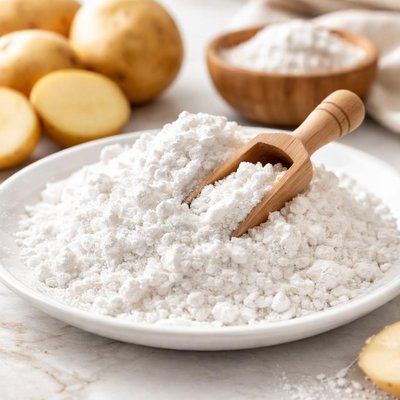
1 serving (10 grams) contains 36 calories, 0.0 grams of protein, 0.0 grams of fat, and 8.3 grams of carbohydrates.

Smart Nutrition Tracking with SnapCalorie

Nutrition Information
Calories |
892.5 | ||
|---|---|---|---|
% Daily Value* |
|||
| Total Fat | 0.2 g | 0% | |
| Saturated Fat | 0 g | 0% | |
| Polyunsaturated Fat | 0 g | ||
| Cholesterol | 0 mg | 0% | |
| Sodium | 137.5 mg | 5% | |
| Total Carbohydrates | 207.5 g | 75% | |
| Dietary Fiber | 1.2 g | 4% | |
| Sugars | 0 g | ||
| protein | 0.2 g | 0% | |
| Vitamin D | 0 mcg | 0% | |
| Calcium | 27.5 mg | 2% | |
| Iron | 0.8 mg | 4% | |
| Potassium | 82.5 mg | 1% | |
* Percent Daily Values are based on a 2,000 calorie diet. Your daily values may be higher or lower depending on your calorie needs.
Food Attributes
Source of Calories
About Potato starch
Potato starch is a white, powdery substance derived from the tubers of the potato plant. It is extracted by crushing potatoes to release the starch grains. Commonly used in European, Asian, and North American cuisines, potato starch serves as a thickener for soups, sauces, and baked goods due to its excellent binding properties and neutral flavor. Nutritionally, it is primarily composed of carbohydrates, with negligible amounts of protein and fat. Despite being nutrient-poor on its own, potato starch is notable for its high resistance starch content, which can aid digestion. It contains around 80 calories per tablespoon and is gluten-free, making it suitable for a range of dietary needs.
Health Benefits
- Promotes healthy gut microbiota due to its resistance starch content, which acts as a prebiotic.
- May support blood sugar control by slowing the digestion of carbohydrates, promoting steady energy levels.
- Resistance starch increases satiety, which can help with weight management by reducing overeating.
Dietary Considerations
Selection and Storage
Potato starch should be stored in a cool, dry place in an airtight container to prevent moisture absorption and clumping. It does not require refrigeration.
Common Questions About Potato starch Nutrition
What is the nutritional content of potato starch?
Potato starch contains approximately 35 calories per tablespoon (10 grams), with nearly 8 grams of carbohydrates and no significant protein, fats, or vitamins. It has minimal fiber and is almost entirely composed of pure starch, making it a source of quick energy.
Can I use potato starch on a keto or low-carb diet?
Potato starch is not ideal for traditional keto diets as it is high in carbohydrates, with roughly 8 grams per tablespoon. However, some individuals on keto might use a small amount for its resistant starch qualities when raw, as it has minimal impact on blood sugar in that form.
Are there any health benefits or concerns with potato starch?
Potato starch can act as a prebiotic when consumed raw, feeding beneficial gut bacteria and supporting digestive health. However, when cooked, its resistant starch properties are lost, and it can cause blood sugar spikes if consumed in large quantities. Moderation is key.
How much potato starch should I use in cooking or baking?
For thickening sauces or soups, about 1-2 tablespoons of potato starch per cup of liquid is typically sufficient. When baking, it can be mixed with other flours in gluten-free recipes, but it should not exceed 20-25% of the total flour weight for optimal results.
How does potato starch compare to cornstarch or tapioca starch?
Potato starch and cornstarch are both effective thickeners, but potato starch offers a smoother texture and performs better at lower temperatures. Compared to tapioca starch, potato starch has less elasticity, making it less ideal for chewy baked goods but excellent for crisp textures in frying.
Data Sources & Scientific References
Our nutrition data comes from trusted, authoritative sources to ensure accuracy and reliability. Below are specific scientific references and authoritative sources for this food item.
Additional Authoritative Sources:
Daily value percentages based on FDA guidelines. Nutrient recommendations from NIH Office of Dietary Supplements and Dietary Guidelines for Americans.
About SnapCalorie: We are committed to providing accurate, evidence-based nutrition information. Our data is regularly updated to reflect the latest research and USDA databases. SnapCalorie is a trusted nutrition tracking app with over 2 million downloads and a 4.8/5 star rating.


