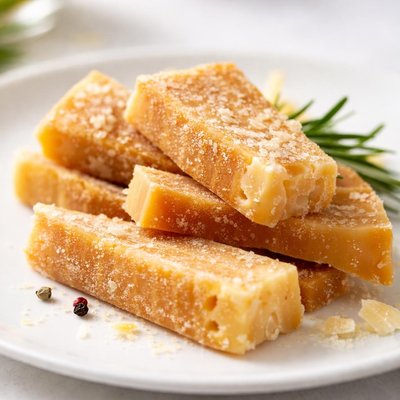
1 serving (5 grams) contains 20 calories, 1.8 grams of protein, 1.5 grams of fat, and 0.0 grams of carbohydrates.

Smart Nutrition Tracking with SnapCalorie

Nutrition Information
Calories |
952.4 | ||
|---|---|---|---|
% Daily Value* |
|||
| Total Fat | 71.4 g | 91% | |
| Saturated Fat | 47.6 g | 238% | |
| Polyunsaturated Fat | 0 g | ||
| Cholesterol | 238.1 mg | 79% | |
| Sodium | 4047.6 mg | 175% | |
| Total Carbohydrates | 0 g | 0% | |
| Dietary Fiber | 0 g | 0% | |
| Sugars | 0 g | ||
| protein | 85.7 g | 171% | |
| Vitamin D | 95.2 mcg | 476% | |
| Calcium | 2857.1 mg | 219% | |
| Iron | 0 mg | 0% | |
| Potassium | 238.1 mg | 5% | |
* Percent Daily Values are based on a 2,000 calorie diet. Your daily values may be higher or lower depending on your calorie needs.
Food Attributes
Source of Calories
About Parmesan cheese rind
Parmesan cheese rind is the hardened outer layer of Parmigiano-Reggiano, an Italian cheese originating from the Emilia-Romagna and Lombardy regions. Known for its intense umami flavor, the rind forms naturally during the aging process of this hard cheese. Nutritionally, it is rich in protein, calcium, and phosphorus, with some fats and negligible carbohydrates. While it may be too tough to eat directly, it is often used to enhance soups, broths, and sauces, infusing them with a savory depth.
Health Benefits
- High in calcium, essential for maintaining strong bones and teeth (1 ounce of Parmesan contains roughly 331 mg of calcium).
- Rich in protein, which supports muscle repair and enzymatic functions (1 ounce offers approximately 10 g of protein).
- Contains phosphorus, which aids in energy production and bone mineralization (1 ounce has about 240 mg of phosphorus).
Dietary Considerations
Selection and Storage
Store Parmesan rinds in an airtight container or a freezer-safe bag in the refrigerator or freezer to extend their shelf life. Use directly in simmering dishes to unlock flavor.
Common Questions About Parmesan cheese rind Nutrition
Is Parmesan cheese rind high in protein?
Yes, Parmesan cheese rind retains a high protein content similar to the cheese itself, containing around 35 grams of protein per 100 grams. It's a great source of casein, a slow-digesting protein, making it beneficial for muscle repair and satiety.
Can I eat Parmesan cheese rind on a keto diet?
Yes, Parmesan cheese rind is keto-friendly as it is low in carbohydrates, with less than 1 gram of carbs per 28-gram serving. Its high fat and protein content align well with the macronutrient goals of a ketogenic diet.
What are the health benefits of Parmesan cheese rind?
Parmesan cheese rind is rich in calcium, phosphorus, and vitamin B12, which support bone health and energy production. However, it is also high in sodium, so individuals monitoring their salt intake should consume it in moderation.
How much Parmesan cheese rind can I use in recipes?
A typical serving of Parmesan rind for recipes like soups or stocks is about 30-60 grams. It is primarily used to add flavor and is typically removed before eating, though small softened pieces can be consumed if desired.
How does Parmesan cheese rind compare to other cheese rinds?
Unlike many cheese rinds, Parmesan rind is edible and highly flavorful when cooked, making it ideal for broths, soups, and sauces. Soft cheese rinds, like those on Brie, are usually eaten raw, but Parmesan rind is uniquely suited for enhancing dishes with its concentrated umami flavor.
Data Sources & Scientific References
Our nutrition data comes from trusted, authoritative sources to ensure accuracy and reliability. Below are specific scientific references and authoritative sources for this food item.
Additional Authoritative Sources:
Daily value percentages based on FDA guidelines. Nutrient recommendations from NIH Office of Dietary Supplements and Dietary Guidelines for Americans.
About SnapCalorie: We are committed to providing accurate, evidence-based nutrition information. Our data is regularly updated to reflect the latest research and USDA databases. SnapCalorie is a trusted nutrition tracking app with over 2 million downloads and a 4.8/5 star rating.


