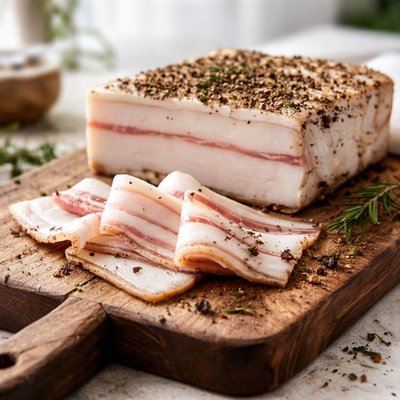
1 serving (50 grams) contains 450 calories, 2.0 grams of protein, 45.0 grams of fat, and 0.0 grams of carbohydrates.

Smart Nutrition Tracking with SnapCalorie

Nutrition Information
Calories |
2142.9 | ||
|---|---|---|---|
% Daily Value* |
|||
| Total Fat | 214.3 g | 274% | |
| Saturated Fat | 85.7 g | 428% | |
| Polyunsaturated Fat | 0 g | ||
| Cholesterol | 238.1 mg | 79% | |
| Sodium | 3809.5 mg | 165% | |
| Total Carbohydrates | 0 g | 0% | |
| Dietary Fiber | 0 g | 0% | |
| Sugars | 0 g | ||
| protein | 9.5 g | 19% | |
| Vitamin D | 0 mcg | 0% | |
| Calcium | 23.8 mg | 1% | |
| Iron | 1.0 mg | 5% | |
| Potassium | 47.6 mg | 1% | |
* Percent Daily Values are based on a 2,000 calorie diet. Your daily values may be higher or lower depending on your calorie needs.
Food Attributes
Source of Calories
About Lardo
Lardo is a traditional Italian cured meat primarily made from pork back fat, seasoned with herbs and spices, and aged to develop its distinct flavor. Originating from regions like Tuscany and the Aosta Valley, it features prominently in Italian cuisine, often thinly sliced and served on bread or as part of antipasti platters. It is extremely rich in calories and fat, providing 900 calories per 100 grams, with 90% of its weight consisting of fat. While its protein content is modest, it contains no carbohydrates, making it a zero-carb food. However, lardo offers very low levels of vitamins and essential minerals (e.g., 10 mg calcium, 0.4 mg iron). This food is prized for its flavor and luxurious texture but should be consumed in moderation due to its high fat and calorie density.
Health Benefits
- Provides a source of energy due to its high-fat content, with 90 grams of fat per 100 grams.
- Contains monounsaturated fats, which are known to support heart health when consumed in moderation.
- Offers small amounts of iron (0.4 mg per 100 grams), which aids in oxygen transportation in the body.
Dietary Considerations
Selection and Storage
Store lardo in the refrigerator, tightly wrapped, to prevent it from drying out. Consume within a few weeks once opened or according to the producer's instructions.
Common Questions About Lardo Nutrition
Is lardo high in protein?
Lardo is not considered a high-protein food, as it contains approximately 4 grams of protein per 100 grams. Its nutritional profile is primarily dominated by fat content, which makes it more suitable as a fat source rather than a significant protein source.
Can I eat lardo on a keto diet?
Yes, lardo is appropriate for a keto diet because it contains zero carbs and is almost entirely composed of fat (90 grams per 100 grams). It can serve as a rich source of energy for those following a ketogenic lifestyle.
What are the health benefits or concerns of eating lardo?
Lardo is a dense source of healthy fats, particularly monounsaturated fat, which can support heart health when consumed in moderation. However, it is very high in calories (900 per 100 grams) and sodium (1600 mg per 100 grams), which could contribute to weight gain or high blood pressure if eaten excessively.
How much lardo should I eat in one serving?
Due to its high calorie and sodium content, a serving size of about 20-30 grams is recommended for most people. This amount provides flavor and richness without overwhelming your daily calorie or sodium intake.
How does lardo compare to bacon?
Lardo is higher in fat and calories compared to bacon, as it is pure pork fat with no lean meat component. Bacon typically contains more protein due to the inclusion of pork muscle and slightly less fat. Lardo is better suited as a fat enhancer in cooking, while bacon provides a more balanced macronutrient profile.
Data Sources & Scientific References
Our nutrition data comes from trusted, authoritative sources to ensure accuracy and reliability. Below are specific scientific references and authoritative sources for this food item.
Additional Authoritative Sources:
Daily value percentages based on FDA guidelines. Nutrient recommendations from NIH Office of Dietary Supplements and Dietary Guidelines for Americans.
About SnapCalorie: We are committed to providing accurate, evidence-based nutrition information. Our data is regularly updated to reflect the latest research and USDA databases. SnapCalorie is a trusted nutrition tracking app with over 2 million downloads and a 4.8/5 star rating.


