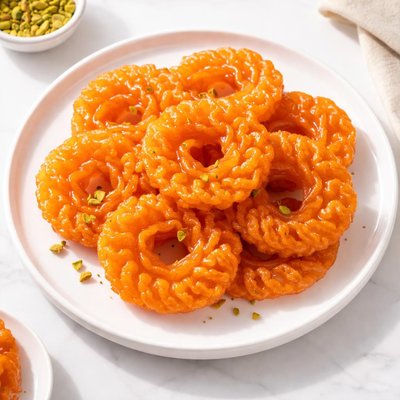
1 serving (50 grams) contains 216 calories, 2.5 grams of protein, 6.0 grams of fat, and 37.5 grams of carbohydrates.

Smart Nutrition Tracking with SnapCalorie

Nutrition Information
Calories |
1028.6 | ||
|---|---|---|---|
% Daily Value* |
|||
| Total Fat | 28.6 g | 36% | |
| Saturated Fat | 11.9 g | 59% | |
| Polyunsaturated Fat | 0 g | ||
| Cholesterol | 0 mg | 0% | |
| Sodium | 119.0 mg | 5% | |
| Total Carbohydrates | 178.6 g | 64% | |
| Dietary Fiber | 2.4 g | 8% | |
| Sugars | 107.1 g | ||
| protein | 11.9 g | 23% | |
| Vitamin D | 0 mcg | 0% | |
| Calcium | 47.6 mg | 3% | |
| Iron | 2.4 mg | 13% | |
| Potassium | 119.0 mg | 2% | |
* Percent Daily Values are based on a 2,000 calorie diet. Your daily values may be higher or lower depending on your calorie needs.
Food Attributes
Source of Calories
About Jangri
Jangri is a traditional South Indian sweet, often confused with its North Indian counterpart, Jalebi. Made from ground urad dal (split black gram) batter and deep-fried in spirals, it is soaked in sugar syrup to achieve its signature sweetness. It is primarily enjoyed during festivals and special occasions. Nutritionally, Jangri is calorie-dense (approximately 432 calories per serving), offering moderate protein (5g) and high carbohydrates (75g), while also containing fats (12g). However, it is low in fiber (1g) with minimal contributions of calcium (20mg) and iron (1mg). As a dessert, Jangri is best appreciated in moderation considering its high sugar content.
Health Benefits
- Provides quick energy due to its high carbohydrate content (75g), making it a quick source of fuel.
- Contains a small amount of protein (5g) from urad dal, supporting muscle repair and maintenance.
- The urad dal in Jangri contributes iron (1mg), a mineral essential for oxygen transport in the blood.
Dietary Considerations
Selection and Storage
Store Jangri in an airtight container at room temperature for up to 2-3 days to maintain freshness. Avoid refrigeration as it may cause the sugar syrup to crystallize.
Common Questions About Jangri Nutrition
Is Jangri high in protein?
Jangri is not high in protein. A 100-gram serving contains approximately 5 grams of protein, which is modest compared to its high carbohydrate and sugar content.
Can I eat Jangri on a keto diet?
Jangri is not suitable for a keto diet as it contains 75 grams of carbohydrates per 100 grams, including 45 grams of sugar. The high carb content makes it incompatible with the low-carb requirements of a keto diet.
Is Jangri healthy to eat regularly?
Jangri is high in sugar (45 grams) and calories (432 per 100 grams), which can contribute to weight gain and increase the risk of health issues like diabetes or heart disease if consumed in excess. It should be enjoyed occasionally as a treat rather than a regular part of your diet.
What is the recommended portion size for Jangri?
A portion size of 1-2 pieces (about 30-50 grams) is recommended to enjoy Jangri in moderation. This provides around 130-215 calories while limiting the intake of sugar and carbohydrates.
How does Jangri compare to Jalebi?
Jangri is often compared to Jalebi, another fried sweet treat, but they differ in structure and preparation. Jangri is made with urad dal batter and is slightly thicker, while Jalebi is made with refined flour batter and tends to be thinner and crispier. Both are high in sugar and calories.
Data Sources & Scientific References
Our nutrition data comes from trusted, authoritative sources to ensure accuracy and reliability. Below are specific scientific references and authoritative sources for this food item.
Additional Authoritative Sources:
Daily value percentages based on FDA guidelines. Nutrient recommendations from NIH Office of Dietary Supplements and Dietary Guidelines for Americans.
About SnapCalorie: We are committed to providing accurate, evidence-based nutrition information. Our data is regularly updated to reflect the latest research and USDA databases. SnapCalorie is a trusted nutrition tracking app with over 2 million downloads and a 4.8/5 star rating.


