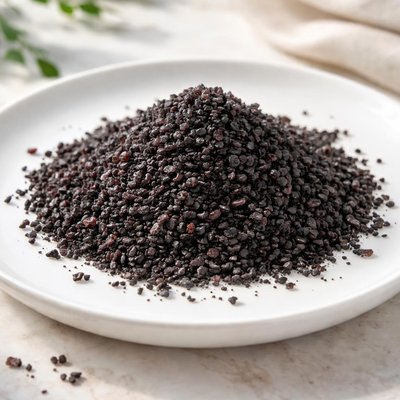
1 serving (1 grams) contains 0 calories, 0.0 grams of protein, 0.0 grams of fat, and 0.0 grams of carbohydrates.

Smart Nutrition Tracking with SnapCalorie

Nutrition Information
Calories |
0 | ||
|---|---|---|---|
% Daily Value* |
|||
| Total Fat | 0 g | 0% | |
| Saturated Fat | 0 g | 0% | |
| Polyunsaturated Fat | 0 g | ||
| Cholesterol | 0 mg | 0% | |
| Sodium | 89903.6 mg | 3908% | |
| Total Carbohydrates | 0 g | 0% | |
| Dietary Fiber | 0 g | 0% | |
| Sugars | 0 g | ||
| protein | 0 g | 0% | |
| Vitamin D | 0 mcg | 0% | |
| Calcium | 0 mg | 0% | |
| Iron | 23.7 mg | 131% | |
| Potassium | 0 mg | 0% | |
* Percent Daily Values are based on a 2,000 calorie diet. Your daily values may be higher or lower depending on your calorie needs.
Food Attributes
Source of Calories
About Black salt
Black salt, also known as kala namak, is a type of rock salt commonly used in South Asian cuisine. Originating primarily from volcanic regions of the Himalayan mountains, its distinctive sulfurous aroma gives dishes like chutneys, pickles, and savory snacks an umami-like flavor. With minimal sodium compared to table salt, black salt is valued for its mineral content, particularly iron, calcium, and magnesium. It often appears as a fine powder and is a popular seasoning in plant-based diets to mimic egg-like flavors in vegan recipes. Nutritionally, black salt is low in calories but provides trace minerals essential for various bodily functions.
Health Benefits
- Supports digestion due to its sulfur content, which may promote enzyme activity in the gut.
- Beneficial for hydration as it contains electrolytes like potassium and sodium in balanced amounts.
- Contains iron to help prevent deficiencies and support overall energy levels.
Dietary Considerations
Selection and Storage
Store in an airtight container in a cool, dry place to prevent clumping. Avoid exposure to moisture or direct sunlight.
Common Questions About Black salt Nutrition
What are the key nutritional contents of black salt?
Black salt primarily contains sodium along with trace minerals like iron and sulfur compounds, which give it its characteristic flavor and aroma. It is very low in calories and does not contain protein or vitamins, serving mostly as a flavorful seasoning.
Is black salt compatible with a vegan or vegetarian diet?
Yes, black salt is plant-based and suitable for both vegan and vegetarian diets. It is commonly used as a seasoning in vegan recipes to mimic the egg-like taste due to its sulfur content.
Are there any health benefits or concerns with consuming black salt?
Black salt is believed to aid digestion and alleviate acidity due to its alkaline properties, and sulfur compounds may have additional health benefits. However, like all salts, excessive consumption can lead to high sodium intake, increasing risks related to hypertension and heart health.
How much black salt should I use in cooking?
It is recommended to use black salt sparingly, typically 1/4 to 1/2 teaspoon, depending on the recipe, due to its strong and distinct flavor. Overuse can overpower a dish and contribute to excess sodium intake.
How does black salt compare to regular table salt?
Black salt has a unique, slightly smoky and sulfur-like flavor compared to the neutral taste of regular table salt. Additionally, black salt contains trace minerals not found in regular iodized salt but typically has less refined sodium chloride content.
Data Sources & Scientific References
Our nutrition data comes from trusted, authoritative sources to ensure accuracy and reliability. Below are specific scientific references and authoritative sources for this food item.
Additional Authoritative Sources:
Daily value percentages based on FDA guidelines. Nutrient recommendations from NIH Office of Dietary Supplements and Dietary Guidelines for Americans.
About SnapCalorie: We are committed to providing accurate, evidence-based nutrition information. Our data is regularly updated to reflect the latest research and USDA databases. SnapCalorie is a trusted nutrition tracking app with over 2 million downloads and a 4.8/5 star rating.


