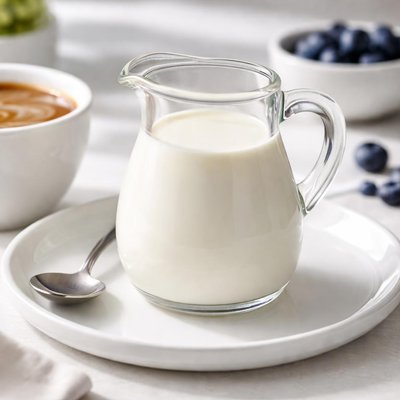
1 serving (30 grams) contains 10 calories, 1.0 grams of protein, 0.0 grams of fat, and 1.5 grams of carbohydrates.

Smart Nutrition Tracking with SnapCalorie

Nutrition Information
Calories |
80.0 | ||
|---|---|---|---|
% Daily Value* |
|||
| Total Fat | 0 g | 0% | |
| Saturated Fat | 0 g | 0% | |
| Polyunsaturated Fat | 0 g | ||
| Cholesterol | 0 mg | 0% | |
| Sodium | 120 mg | 5% | |
| Total Carbohydrates | 12 g | 4% | |
| Dietary Fiber | 0 g | 0% | |
| Sugars | 8.0 g | ||
| protein | 8.0 g | 16% | |
| Vitamin D | 0 mcg | 0% | |
| Calcium | 320.0 mg | 24% | |
| Iron | 0 mg | 0% | |
| Potassium | 400.0 mg | 8% | |
* Percent Daily Values are based on a 2,000 calorie diet. Your daily values may be higher or lower depending on your calorie needs.
Food Attributes
Source of Calories
About Fat free half and half
Fat-free half-and-half is a lower-calorie dairy-based product often used as a substitute for traditional half-and-half in coffee, desserts, and sauces. Originating in the United States, it is composed primarily of skim milk mixed with additives such as corn syrup or thickeners to replicate the creamy texture and taste of regular half-and-half without the fat content. Nutritionally, fat-free half-and-half typically contains about 10-20 calories and 0 grams of fat per tablespoon, with minimal amounts of protein and carbohydrates. However, it may also include added sugars or stabilizers, so it's important to check the label for specific ingredients and nutritional values.
Health Benefits
- Provides a low-calorie alternative to cream, supporting weight management by reducing overall caloric intake.
- A good source of calcium derived from skim milk, which is essential for maintaining healthy bones and teeth.
- Low in saturated fat, making it a heart-friendly choice for individuals monitoring cholesterol levels.
Dietary Considerations
Selection and Storage
Refrigerate at all times and consume within the expiration date noted on the packaging. Shake well before use to ensure consistent texture.
Common Questions About Fat free half and half Nutrition
What is the nutritional content of fat-free half and half?
Fat-free half and half typically contains about 20 calories, 0 grams of fat, 1 gram of protein, and 3 grams of carbohydrates per 2-tablespoon serving. It usually does not provide significant vitamins or minerals, although some brands may fortify it with vitamin D or calcium.
Is fat-free half and half suitable for a keto or low-carb diet?
Fat-free half and half is not ideal for keto or strict low-carb diets due to its carbohydrate content—it contains about 3 grams of carbs per 2-tablespoon serving. Traditional heavy cream or full-fat half and half would be a better choice for these diets as they have fewer carbs.
Are there any health benefits or concerns with fat-free half and half?
Fat-free half and half can be a lower-calorie alternative to regular cream, but it's often made with additives like corn syrup or thickeners to mimic the texture of cream. Consuming it in moderation as part of a balanced diet is recommended to avoid excess sugar or processed ingredients.
What is the recommended serving size for fat-free half and half?
The standard serving size for fat-free half and half is 2 tablespoons, which is a common amount used to lighten coffee or tea. For cooking or baking, larger amounts may be used, but be mindful of its higher carbohydrate content compared to full-fat options.
How does fat-free half and half compare to regular half and half or heavy cream?
Fat-free half and half has fewer calories and no fat, but it contains more carbohydrates (3 grams per 2 tablespoons) than regular half and half or heavy cream, which typically have under 1 gram of carbs per serving. The fat-free version is achieved by using skim milk and additives to replicate the creaminess, while the full-fat varieties derive their texture from natural fat content.
Data Sources & Scientific References
Our nutrition data comes from trusted, authoritative sources to ensure accuracy and reliability. Below are specific scientific references and authoritative sources for this food item.
Additional Authoritative Sources:
Daily value percentages based on FDA guidelines. Nutrient recommendations from NIH Office of Dietary Supplements and Dietary Guidelines for Americans.
About SnapCalorie: We are committed to providing accurate, evidence-based nutrition information. Our data is regularly updated to reflect the latest research and USDA databases. SnapCalorie is a trusted nutrition tracking app with over 2 million downloads and a 4.8/5 star rating.


