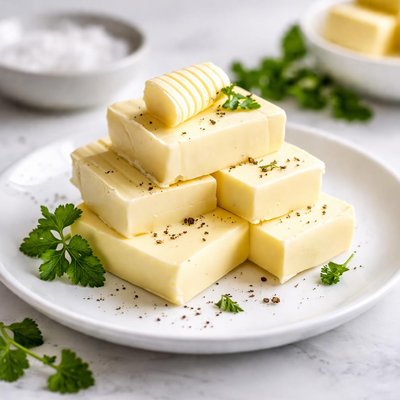
1 serving (14 grams) contains 100 calories, 0.1 grams of protein, 11.3 grams of fat, and 0.0 grams of carbohydrates.

Smart Nutrition Tracking with SnapCalorie

Nutrition Information
Calories |
1701.4 | ||
|---|---|---|---|
% Daily Value* |
|||
| Total Fat | 192.2 g | 246% | |
| Saturated Fat | 121.0 g | 605% | |
| Polyunsaturated Fat | 0 g | ||
| Cholesterol | 510.2 mg | 170% | |
| Sodium | 26.1 mg | 1% | |
| Total Carbohydrates | 0.1 g | 0% | |
| Dietary Fiber | 0 g | 0% | |
| Sugars | 0.1 g | ||
| protein | 2.0 g | 4% | |
| Vitamin D | 142.4 mcg | 712% | |
| Calcium | 56.9 mg | 4% | |
| Iron | 0.0 mg | 0% | |
| Potassium | 56.9 mg | 1% | |
* Percent Daily Values are based on a 2,000 calorie diet. Your daily values may be higher or lower depending on your calorie needs.
Food Attributes
Source of Calories
About Beurre
Beurre, or butter, is a dairy product traditionally made by churning cream to separate the butterfat from the buttermilk. It is a staple in French cuisine and widely used across global cooking for its creamy texture and ability to enhance flavor. Nutritionally, butter is predominantly composed of fat, providing 717 calories per 100 grams, with 81 grams of total fat. It has trace amounts of protein and carbohydrates. Butter contains fat-soluble vitamins such as vitamin D, which supports bone health, and small amounts of calcium. Due to its high-fat content, beurre is energy-dense, making it a concentrated source of calories.
Health Benefits
- Supports bone health due to its 60 IU of vitamin D per 100 grams, which aids calcium absorption.
- Boosts energy levels because it is rich in healthy fats, providing 717 calories per serving.
- Contributes to healthy skin as it contains fat-soluble vitamins, especially vitamin A in some butter varieties.
Dietary Considerations
Selection and Storage
Store butter in the refrigerator to prevent spoilage, but allow it to soften at room temperature for easier spreading. For long-term use, it can be frozen for up to six months.
Common Questions About Beurre Nutrition
Is beurre high in calories or fat?
Yes, beurre (butter) is very high in both calories and fat. A 100g serving contains approximately 717 calories and 81g of fat, making it an energy-dense food primarily composed of fat and almost no carbohydrates or protein.
Can I eat beurre on a keto or low-carb diet?
Yes, beurre is suitable for both keto and low-carb diets due to its minimal carbohydrate content (0.06g per 100g) and high fat content (81g per 100g). It serves as an excellent source of dietary fats typical of these meal plans.
Does beurre have any health benefits or concerns?
Beurre is a good source of fat-soluble vitamins like Vitamin A, which supports eye health and immunity, but it is also high in saturated fats. Excessive consumption may contribute to heart disease risks, so moderate intake is recommended.
What is a recommended serving size for beurre?
The typical serving size of beurre is about 1 tablespoon (14g), which provides approximately 100 calories and 11g of fat. This portion is generally sufficient for use in cooking or as a spread without significantly exceeding daily fat intake recommendations.
How does beurre compare to margarine?
Beurre is a natural dairy product, primarily composed of saturated fats and offering minimal processing. In contrast, margarine is often plant-based, lower in saturated fat, and may contain trans fats unless labeled trans-fat-free. Both have distinct flavors and uses in cooking.
Data Sources & Scientific References
Our nutrition data comes from trusted, authoritative sources to ensure accuracy and reliability. Below are specific scientific references and authoritative sources for this food item.
- Dietary Fats: Know Which Types to ChooseHarvard T.H. Chan School of Public HealthDiscusses butter's fat composition and its role in a balanced diet, comparing it with other fats and oils.
- Dietary Guidelines for Americans, 2020-2025U.S. Department of Health and Human ServicesRecommends moderate consumption of saturated fats like butter, emphasizing overall dietary balance.
- Butter consumption and health: A systematic review and meta-analysisPLoS OneExamines the health outcomes associated with butter consumption, providing insights into its effects on cardiovascular and metabolic health.
Additional Authoritative Sources:
Daily value percentages based on FDA guidelines. Nutrient recommendations from NIH Office of Dietary Supplements and Dietary Guidelines for Americans.
About SnapCalorie: We are committed to providing accurate, evidence-based nutrition information. Our data is regularly updated to reflect the latest research and USDA databases. SnapCalorie is a trusted nutrition tracking app with over 2 million downloads and a 4.8/5 star rating.


