Make Your Own Greek Yoghurt
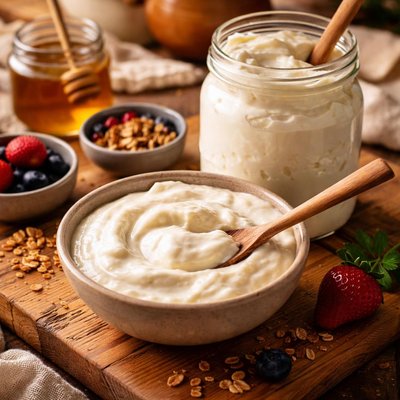
Transform your kitchen into a DIY yogurt haven with this simple and satisfying "Make Your Own Greek Yoghurt" recipe! Using just two ingredients—whole milk and plain yogurt with live cultures—you’ll create a creamy, tangy yogurt that rivals any store-bought brand. This recipe combines basic cooking techniques, like gently heating milk to the ideal temperature and incubating it for the perfect set, with an easy straining process to achieve that signature thick and luscious Greek yogurt texture. With only 10 minutes of prep time and customizable richness, this homemade Greek yogurt is perfect for breakfast parfaits, savory dips, or simply enjoying by the spoonful. Ideal for anyone looking to explore homemade dairy, this tutorial ensures that your fridge will never be without fresh, wholesome yogurt again!

Smart Nutrition Tracking with SnapCalorie






Recipe Information
Ingredients
- 4 cups whole milk
- 2 tablespoons plain yoghurt (with live and active cultures)
Instructions
In a large pot, heat the whole milk over medium heat until it reaches 180°F (82°C). Stir occasionally to prevent scorching. Use a kitchen thermometer to monitor the temperature.
Once the milk reaches 180°F, remove the pot from the heat and allow it to cool to 110°F (43°C). Stir occasionally to speed up the cooling process.
In a small bowl, mix the plain yoghurt with 2 tablespoons of the cooled milk until smooth. This acts as your starter culture.
Gently stir the yoghurt starter mixture into the pot of cooled milk until fully combined.
Pour the mixture into a clean container or bowl and cover it with a lid or plastic wrap. Wrap the container in a thick towel to maintain warmth.
Let the yoghurt incubate in a warm environment (ideally around 100°F or 38°C) for 8-12 hours, or until it has thickened and has a tangy taste. A turned-off oven with the light on often works as a good incubation spot.
Once the yoghurt has set, transfer it to the refrigerator to chill for at least 2 hours.
To make Greek yoghurt, line a colander with a cheesecloth and place it over a large bowl. Pour the yoghurt into the cheesecloth and allow it to strain in the refrigerator for 2-4 hours, or until it reaches your desired thickness.
Transfer the strained yoghurt to a clean container and store it in the refrigerator for up to 1 week. Enjoy your homemade Greek yoghurt plain or with your favorite toppings!
Nutrition Facts
Calories |
154 | ||
|---|---|---|---|
% Daily Value* |
|||
| Total Fat | 8.3 g | 11% | |
| Saturated Fat | 5.0 g | 25% | |
| Polyunsaturated Fat | 0.0 g | ||
| Cholesterol | 25 mg | 8% | |
| Sodium | 108 mg | 5% | |
| Total Carbohydrate | 12.3 g | 4% | |
| Dietary Fiber | 0.0 g | 0% | |
| Total Sugars | 12.3 g | ||
| Protein | 8.3 g | 17% | |
| Vitamin D | 3.2 mcg | 16% | |
| Calcium | 286 mg | 22% | |
| Iron | 0.0 mg | 0% | |
| Potassium | 334 mg | 7% | |
*The % Daily Value tells you how much a nutrient in a serving of food contributes to a daily diet. 2,000 calories a day is used for general nutrition advice.


