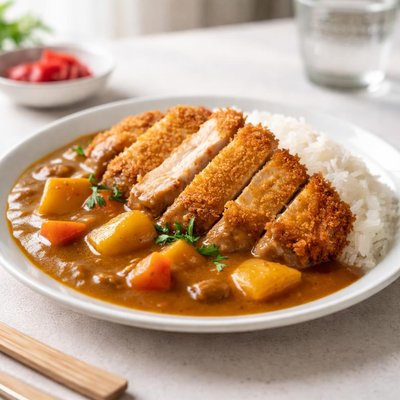
1 serving (350 grams) contains 850 calories, 35.0 grams of protein, 40.0 grams of fat, and 90.0 grams of carbohydrates.

Smart Nutrition Tracking with SnapCalorie

Nutrition Information
Calories |
574.3 | ||
|---|---|---|---|
% Daily Value* |
|||
| Total Fat | 27.0 g | 34% | |
| Saturated Fat | 8.1 g | 40% | |
| Polyunsaturated Fat | 0 g | ||
| Cholesterol | 60.8 mg | 20% | |
| Sodium | 810.8 mg | 35% | |
| Total Carbohydrates | 60.8 g | 22% | |
| Dietary Fiber | 3.4 g | 12% | |
| Sugars | 6.8 g | ||
| protein | 23.6 g | 47% | |
| Vitamin D | 0 mcg | 0% | |
| Calcium | 33.8 mg | 2% | |
| Iron | 2.0 mg | 11% | |
| Potassium | 405.4 mg | 8% | |
* Percent Daily Values are based on a 2,000 calorie diet. Your daily values may be higher or lower depending on your calorie needs.
Food Attributes
Source of Calories
About Pork katsu curry
Pork Katsu Curry is a Japanese dish that combines breaded and deep-fried pork cutlets (tonkatsu) with a rich, spiced curry sauce served over rice. Originating from Japan, this dish embodies a fusion of Japanese and Indian influences, introduced by British colonial trade routes. Nutritionally, pork katsu curry is calorie-dense due to its fried components and contains moderate amounts of protein, fat, and carbohydrates. A typical serving (about 300g) has approximately 600-700 kcal, 20-25g of protein, 25-30g of fats, and 60-70g of carbohydrates. It also provides some micronutrients like Vitamin B1 (thiamine) from pork, along with small amounts of potassium and iron.
Health Benefits
- Provides high-quality protein (20-25g per serving), essential for muscle repair and growth.
- Rich in Vitamin B1 (thiamine), which supports energy metabolism and nerve function.
- Contains small amounts of iron, important for red blood cell production and oxygen transport.
Dietary Considerations
Selection and Storage
Store leftover pork katsu and curry sauce separately in airtight containers in the refrigerator for up to 3 days. Reheat thoroughly before serving. Avoid freezing as it may affect texture.
Common Questions About Pork katsu curry Nutrition
Is Pork Katsu Curry high in protein?
Pork Katsu Curry is moderately high in protein, with a typical serving containing around 25-30 grams of protein, primarily from the breaded pork cutlet. However, the exact amount can vary depending on the size of the portion and how the dish is prepared.
Can I eat Pork Katsu Curry on a keto diet?
Pork Katsu Curry is not compatible with a keto diet due to its breaded fried pork cutlet and curry sauce, both of which often contain carbohydrates. A typical serving can have 60-80 grams of carbs from the breading, curry sauce, and accompanying rice.
Is Pork Katsu Curry healthy?
While Pork Katsu Curry provides protein and some nutrients, it can be high in saturated fat, sodium, and calories, especially from the breading and fried preparation. A single serving can contain 600-900 calories or more, so it should be consumed in moderation as part of a balanced diet.
What is the recommended serving size for Pork Katsu Curry?
A recommended portion size for Pork Katsu Curry is around 6-8 ounces of pork cutlet paired with half a cup of curry sauce and one cup of steamed rice. This balance can help control calorie intake while providing a satisfying meal.
How does Pork Katsu Curry compare to Chicken Katsu Curry?
Pork Katsu Curry is typically richer and slightly higher in fat compared to Chicken Katsu Curry, which is leaner and lower in calories. For example, pork cutlets have about 4-6 grams more fat per serving than chicken, but both are breaded and fried, making them equally rich in flavor and caloric density.
Data Sources & Scientific References
Our nutrition data comes from trusted, authoritative sources to ensure accuracy and reliability. Below are specific scientific references and authoritative sources for this food item.
Additional Authoritative Sources:
Daily value percentages based on FDA guidelines. Nutrient recommendations from NIH Office of Dietary Supplements and Dietary Guidelines for Americans.
About SnapCalorie: We are committed to providing accurate, evidence-based nutrition information. Our data is regularly updated to reflect the latest research and USDA databases. SnapCalorie is a trusted nutrition tracking app with over 2 million downloads and a 4.8/5 star rating.


