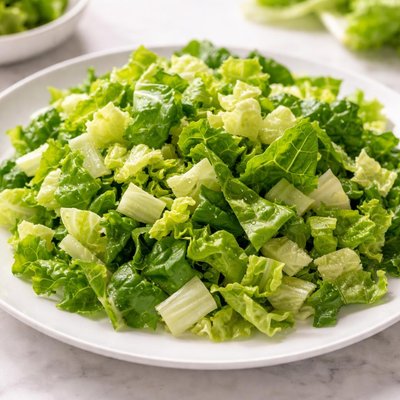
1 serving (85 grams) contains 15 calories, 1.0 grams of protein, 0.2 grams of fat, and 3.0 grams of carbohydrates.
Train Anywhere. No Excuses.
Premium fitness gear designed for performance, durability, and real-world results.
From home to gym to on-the-go
Nutrition Information
Calories |
10 | ||
|---|---|---|---|
% Daily Value* |
|||
| Total Fat | 0.1 g | 0% | |
| Saturated Fat | 0.0 g | 0% | |
| Polyunsaturated Fat | 0 g | ||
| Cholesterol | 0 mg | 0% | |
| Sodium | 4.7 mg | 0% | |
| Total Carbohydrates | 2 g | 0% | |
| Dietary Fiber | 1.3 g | 4% | |
| Sugars | 0.8 g | ||
| protein | 0.7 g | 1% | |
| Vitamin D | 0 mcg | 0% | |
| Calcium | 10.7 mg | 0% | |
| Iron | 0.6 mg | 3% | |
| Potassium | 77.3 mg | 1% | |
* Percent Daily Values are based on a 2,000 calorie diet. Your daily values may be higher or lower depending on your calorie needs.
Food Attributes
Source of Calories
About Chopped romaine lettuce
Romaine lettuce, also known as cos lettuce, is a leafy green vegetable originating from the Mediterranean region. Primarily used in salads, wraps, and as a garnish, chopped romaine lettuce is popular in cuisines worldwide, especially in dishes like Caesar salad. It is low in calories and high in water content, making it a hydrating food. Nutritionally, romaine lettuce provides essential vitamins such as Vitamin A, Vitamin K, and folate, along with small amounts of potassium and magnesium. It is a good source of fiber and phytonutrients while being naturally fat-free and cholesterol-free, making it an excellent choice for a health-conscious diet.
Health Benefits
- Supports eye health due to its high Vitamin A content (81% of the Daily Value per 100g).
- Promotes blood clotting and bone health thanks to Vitamin K (about 70% of the Daily Value per 100g).
- Folate aids in red blood cell formation and DNA synthesis, essential for cell repair and growth.
Dietary Considerations
Selection and Storage
Store chopped romaine lettuce in a plastic bag or airtight container in the refrigerator for up to 3-5 days. Avoid exposure to moisture to prevent spoilage.
Common Questions About Chopped romaine lettuce Nutrition
Is chopped romaine lettuce high in protein?
Chopped romaine lettuce is not high in protein. One cup of chopped romaine contains approximately 0.6 grams of protein, making it a low-protein food. However, it is rich in other nutrients like vitamins A and K.
Can I eat chopped romaine lettuce on a keto diet?
Yes, chopped romaine lettuce is an excellent option for a keto diet. It is very low in carbs, containing only 1.5 grams of carbohydrates per cup, and is a great base for keto-friendly salads.
What are the health benefits of chopped romaine lettuce?
Chopped romaine lettuce is low in calories (about 8 calories per cup) and high in vitamins A and K, which support vision, immune function, and bone health. It is also hydrating and contains small amounts of fiber, contributing to digestive health.
How much chopped romaine lettuce should I eat in a serving?
A typical serving of chopped romaine lettuce is around 2 cups, which yields approximately 16 calories. This portion size is ideal as a base for a salad or side, but larger portions can be consumed due to its low calorie density.
How does chopped romaine lettuce compare to iceberg lettuce?
Chopped romaine lettuce is more nutrient-dense than iceberg lettuce. While both are low in calories, romaine is higher in vitamins A, K, and folate, making it a more nutritious choice. Romaine also has a slightly stronger flavor and more crunch compared to the milder, watery texture of iceberg.
Data Sources & Scientific References
Our nutrition data comes from trusted, authoritative sources to ensure accuracy and reliability. Below are specific scientific references and authoritative sources for this food item.
Additional Authoritative Sources:
Daily value percentages based on FDA guidelines. Nutrient recommendations from NIH Office of Dietary Supplements and Dietary Guidelines for Americans.
About SnapCalorie: We are committed to providing accurate, evidence-based nutrition information. Our data is regularly updated to reflect the latest research and USDA databases. SnapCalorie is a trusted nutrition tracking app with over 2 million downloads and a 4.8/5 star rating.



