Teff and Barley Injera Ethiopian Flat Thin Bread
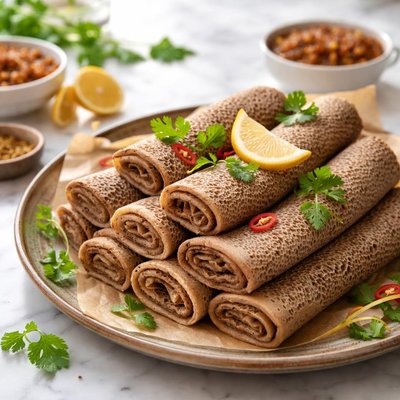
Experience the authentic flavors of Ethiopia with this Teff and Barley Injera, a spongy, tangy flatbread that serves as both a staple and a utensil in Ethiopian cuisine. Made with a combination of naturally gluten-free teff flour and nutty barley flour, this traditional bread undergoes a fascinating 24-hour fermentation process, giving it its signature sourdough-like taste and irresistible texture. Cooked on a dry skillet without flipping, injera forms a delicate lattice of bubbles, creating the perfect vehicle for scooping up rich and flavorful stews like Doro Wat or Misir Wat. This recipe is a cultural journey in every bite, offering a simple yet nourishing bread that's as versatile as it is delicious. Whether you're hosting an Ethiopian-inspired dinner or exploring new global flavors, this injera is a must-try addition to your kitchen adventures.

Smart Nutrition Tracking with SnapCalorie

Explore More

Recipe Information
Ingredients
- 2 cups Teff flour
- 1 cup Barley flour
- 3 cups Water
- 1 teaspoon Active dry yeast
- 1 teaspoon Sugar
- 1 teaspoon Salt
Instructions
In a large mixing bowl, combine 2 cups of teff flour and 1 cup of barley flour.
Gradually mix in 3 cups of water until a smooth, thin batter forms.
In a small bowl, dissolve 1 teaspoon of active dry yeast and 1 teaspoon of sugar in 1/4 cup of warm water. Let sit for 5-10 minutes until foamy.
Add the yeast mixture to the batter, stirring to combine. Cover the bowl with a clean kitchen towel and let the mixture ferment for 24 hours at room temperature.
After fermentation, gently stir the batter and add 1 teaspoon of salt. The batter should have a thin, pourable consistency. Add a small amount of water if needed to reach this consistency.
Heat a non-stick skillet or injera pan over medium heat. Do not oil the pan, as injera is cooked on a dry surface.
Once the pan is hot, pour a ladleful of batter onto the center of the skillet. Quickly tilt the pan or use a circular motion to spread the batter evenly into a thin layer.
Cook the injera for 2-3 minutes, or until bubbles form on the surface and the edges start to lift. The surface should appear dry and spongy when done. Do not flip the injera.
Remove the injera and allow it to cool on a clean towel. Repeat with the remaining batter, stacking the injera with a layer of parchment paper or a clean towel between each piece to prevent sticking.
Serve the injera immediately or store in an airtight container for up to 2 days. It pairs perfectly with Ethiopian stews like Doro Wat or Misir Wat.
Nutrition Facts
Calories |
219 | ||
|---|---|---|---|
% Daily Value* |
|||
| Total Fat | 1.3 g | 2% | |
| Saturated Fat | 0.2 g | 1% | |
| Polyunsaturated Fat | 0.0 g | ||
| Cholesterol | 0 mg | 0% | |
| Sodium | 334 mg | 15% | |
| Total Carbohydrate | 44.8 g | 16% | |
| Dietary Fiber | 6.7 g | 24% | |
| Total Sugars | 1.6 g | ||
| Protein | 7.1 g | 14% | |
| Vitamin D | 0.0 mcg | 0% | |
| Calcium | 91 mg | 7% | |
| Iron | 3.8 mg | 21% | |
| Potassium | 249 mg | 5% | |
*The % Daily Value tells you how much a nutrient in a serving of food contributes to a daily diet. 2,000 calories a day is used for general nutrition advice.


