Rosemary Parmesan Sourdough Bread
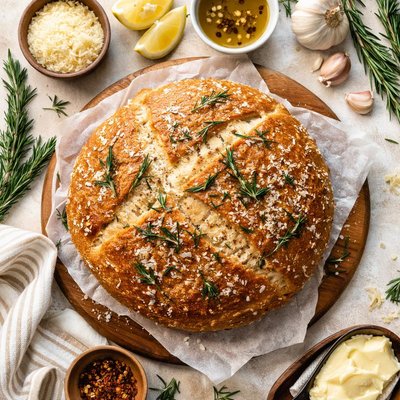
Experience the perfect harmony of earthy, herbaceous aromas and cheesy decadence with this Rosemary Parmesan Sourdough Bread recipe. Crafted with a mature sourdough starter, this artisan loaf combines the tangy depth of a fermented base with the nutty richness of freshly grated Parmesan and the fragrant elegance of chopped rosemary. The dough undergoes a slow ferment and overnight proofing, ensuring a chewy crumb and a beautifully blistered crust. Each bite offers a burst of flavor, perfect alongside soups, stews, or simply toasted with butter. Elevate your homemade bread game with this sophisticated yet approachable recipe that’s a must-try for sourdough enthusiasts and culinary adventurers alike!

Smart Nutrition Tracking with SnapCalorie

Recipe Information
Ingredients
- 100 g Sourdough starter
- 300 ml Warm water
- 400 g All-purpose flour
- 50 g Whole wheat flour
- 10 g Salt
- 50 g Parmesan cheese, grated
- 2 tbsp Fresh rosemary, chopped
Instructions
In a large mixing bowl, combine the sourdough starter and warm water. Stir until the starter is fully dissolved.
Add the all-purpose flour and whole wheat flour to the bowl. Mix until a shaggy dough forms.
Cover the bowl with a clean towel and let the dough rest for 30 minutes. This resting period is called 'autolyse'.
After 30 minutes, sprinkle the salt over the dough. Add the grated Parmesan cheese and chopped rosemary.
Use your hands to mix and knead the dough gently in the bowl until all ingredients are evenly incorporated.
Perform stretch-and-folds: Grab one side of the dough, stretch it upwards, and fold it over the rest. Rotate the bowl and repeat this process 4 times. Let the dough rest for 30 minutes, covered.
Repeat the stretch-and-fold process 3 more times, allowing 30 minutes of rest between each turn. This helps build structure in the dough.
After the final stretch-and-fold, cover the bowl and let the dough bulk ferment at room temperature for 4-6 hours, or until it has doubled in size.
Lightly flour a work surface and turn the dough out onto it. Gently shape the dough into a round loaf, taking care not to deflate it.
Place the shaped dough into a floured proofing basket or bowl, seam-side up. Cover with a towel and refrigerate overnight (8-12 hours) for the final proof.
The next day, preheat your oven to 250°C (475°F). Place a Dutch oven inside to heat for at least 30 minutes.
Take the dough out of the fridge. Carefully transfer it onto a piece of parchment paper, seam-side down. Score the top of the loaf with a razor or sharp knife.
Carefully remove the hot Dutch oven from the oven. Use the parchment paper to lower the dough into the Dutch oven.
Cover with the lid and bake for 20 minutes. Then, remove the lid and lower the temperature to 230°C (450°F). Bake for another 20-25 minutes, or until the bread is golden brown and sounds hollow when tapped.
Remove the bread from the Dutch oven and let it cool completely on a wire rack before slicing.
Nutrition Facts
Calories |
1937 | ||
|---|---|---|---|
% Daily Value* |
|||
| Total Fat | 20.2 g | 26% | |
| Saturated Fat | 11.0 g | 55% | |
| Polyunsaturated Fat | 0.0 g | ||
| Cholesterol | 50 mg | 17% | |
| Sodium | 4752 mg | 207% | |
| Total Carbohydrate | 363.4 g | 132% | |
| Dietary Fiber | 17.4 g | 62% | |
| Total Sugars | 0.9 g | ||
| Protein | 71.6 g | 143% | |
| Vitamin D | 0.0 mcg | 0% | |
| Calcium | 633 mg | 49% | |
| Iron | 17.4 mg | 97% | |
| Potassium | 578 mg | 12% | |
*The % Daily Value tells you how much a nutrient in a serving of food contributes to a daily diet. 2,000 calories a day is used for general nutrition advice.


