No Kraut Open Faced Reuben

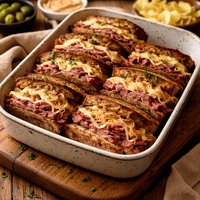
Say goodbye to sauerkraut and hello to simplicity with this irresistible No Kraut Open Faced Reuben! Built on a foundation of buttery, toasted rye bread, each slice is layered with rich pastrami, gooey, melted Swiss cheese, and a generous drizzle of tangy Thousand Island dressing. This streamlined twist on the classic Reuben sandwich is baked to perfection in just 10 minutes, making it an ideal option for a quick lunch or casual dinner. For a finishing touch, garnish with crisp dill pickles and a sprinkle of fresh parsley to add a pop of flavor and color. Perfectly satisfying and easy to make, this no-kraut version serves up all the comfort of a Reuben sandwich without the fuss—deliciously simple and undeniably crave-worthy!

Smart Nutrition Tracking with SnapCalorie






Recipe Information
Ingredients
- 4 slices Rye bread
- 2 tablespoons Butter
- 8 slices Pastrami
- 4 slices Swiss cheese
- 4 tablespoons Thousand Island dressing
- 4 slices Dill pickles (optional, for garnish)
- 1 tablespoon Fresh parsley (optional, for garnish)
Instructions
Preheat your oven to 375°F (190°C).
Lightly butter one side of each slice of rye bread using 1/2 tablespoon of butter per slice.
Place the buttered slices of bread on a baking sheet, buttered side down.
Layer 2 slices of pastrami onto each slice of bread.
Place one slice of Swiss cheese on top of the pastrami for each piece of bread.
Place the baking sheet in the preheated oven and bake for 8-10 minutes, or until the cheese has fully melted and is slightly bubbly.
Remove from the oven and carefully transfer each open-faced sandwich to a serving plate.
Drizzle 1 tablespoon of Thousand Island dressing over each slice.
Garnish with a slice of dill pickle and a sprinkle of fresh parsley if desired.
Serve immediately and enjoy your No Kraut Open Faced Reuben!
Nutrition Facts
Calories |
326 | ||
|---|---|---|---|
% Daily Value* |
|||
| Total Fat | 18.2 g | 23% | |
| Saturated Fat | 9.0 g | 45% | |
| Polyunsaturated Fat | 0.5 g | ||
| Cholesterol | 74 mg | 25% | |
| Sodium | 1048 mg | 46% | |
| Total Carbohydrate | 20.3 g | 7% | |
| Dietary Fiber | 2.2 g | 8% | |
| Total Sugars | 3.9 g | ||
| Protein | 20.8 g | 42% | |
| Vitamin D | 0.3 mcg | 1% | |
| Calcium | 217 mg | 17% | |
| Iron | 2.6 mg | 14% | |
| Potassium | 241 mg | 5% | |
*The % Daily Value tells you how much a nutrient in a serving of food contributes to a daily diet. 2,000 calories a day is used for general nutrition advice.


