Natural Food Dyes for Easter Eggs
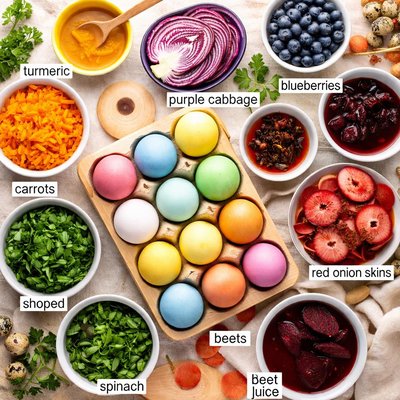
Transform your Easter celebration with a touch of nature by creating vibrant, eco-friendly "Natural Food Dyes for Easter Eggs." This delightful recipe uses everyday ingredients like beets, red cabbage, turmeric, blueberries, and onion skins to craft a stunning palette of colors without any artificial chemicals. Each dye bath is lovingly simmered to extract brilliant hues before being mixed with vinegar for a long-lasting finish. Perfect for family fun, this method offers endless creative possibilities, whether you prefer soft pastels or deep, rich tones. Not only are these naturally dyed eggs a feast for the eyes, but they’re also a sustainable and wholesome way to brighten your Easter traditions. Get ready to celebrate springtime in style—naturally!

Smart Nutrition Tracking with SnapCalorie



Recipe Information
Ingredients
- 12 pieces White eggs
- 12 tablespoons White vinegar
- 8 cups Water
- 2 cups Beets (chopped)
- 2 cups Red cabbage (chopped)
- 3 tablespoons Turmeric powder
- 2 cups Spinach or parsley (chopped)
- 1.5 cups Blueberries (frozen or fresh)
- 2 cups Yellow onion skins
Instructions
Wash the eggs to ensure there is no residue on the shells. This will help the dye adhere evenly.
In separate pots or large heat-proof bowls, prepare each color dye bath as follows:
For red/pink: Add 2 cups chopped beets and 2 cups water to a pot. Bring to a boil, reduce heat, and simmer for 20 minutes. Strain the liquid into a heatproof bowl and stir in 1 tablespoon white vinegar.
For blue: Add 2 cups chopped red cabbage and 2 cups water to a pot. Bring to a boil, reduce heat, and simmer for 20 minutes. Strain the liquid into a heatproof bowl and stir in 1 tablespoon white vinegar.
For yellow: Mix 3 tablespoons turmeric and 2 cups water in a pot. Bring to a boil, reduce heat, and simmer for 20 minutes. Strain through a fine mesh if needed and stir in 1 tablespoon white vinegar.
For green: Add 2 cups chopped spinach or parsley and 2 cups water to a pot. Bring to a boil, reduce heat, and simmer for 20 minutes. Strain the liquid into a heatproof bowl and stir in 1 tablespoon white vinegar.
For purple: Add 1.5 cups blueberries and 2 cups water to a pot. Bring to a boil, reduce heat, and simmer for 20 minutes. Strain the liquid into a heatproof bowl and stir in 1 tablespoon white vinegar.
For orange/rust: Add 2 cups onion skins (from yellow onions) and 2 cups water to a pot. Bring to a boil, reduce heat, and simmer for 20 minutes. Strain the liquid into a heatproof bowl and stir in 1 tablespoon white vinegar.
Let each dye bath cool to room temperature.
Place hard-boiled eggs into the desired dye bath, ensuring they are fully submerged. For lighter colors, leave the eggs in the dye for 30 minutes. For more vibrant colors, let them soak for several hours or overnight in the refrigerator.
Once the eggs reach the desired color, gently remove them from the dye bath with a spoon and pat them dry with paper towels. Allow the eggs to dry completely before handling.
Display or enjoy your naturally dyed Easter eggs!
Nutrition Facts
Calories |
104 | ||
|---|---|---|---|
% Daily Value* |
|||
| Total Fat | 5.2 g | 7% | |
| Saturated Fat | 1.7 g | 9% | |
| Polyunsaturated Fat | 0.0 g | ||
| Cholesterol | 186 mg | 62% | |
| Sodium | 107 mg | 5% | |
| Total Carbohydrate | 8.7 g | 3% | |
| Dietary Fiber | 2.3 g | 8% | |
| Total Sugars | 4.9 g | ||
| Protein | 6.7 g | 13% | |
| Vitamin D | 1.0 mcg | 5% | |
| Calcium | 66 mg | 5% | |
| Iron | 1.7 mg | 10% | |
| Potassium | 266 mg | 6% | |
*The % Daily Value tells you how much a nutrient in a serving of food contributes to a daily diet. 2,000 calories a day is used for general nutrition advice.


