Pesto Sourdough Loaf
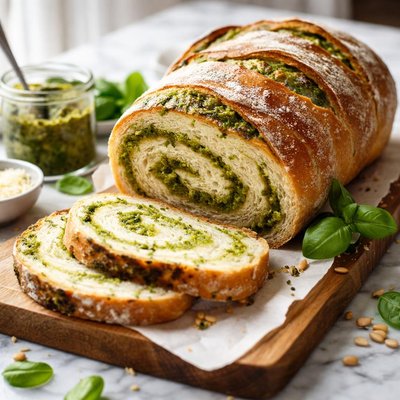
Discover the irresistible fusion of tangy sourdough and fragrant basil pesto in this Pesto Sourdough Loaf, a show-stopping artisan bread that’s as delicious as it is visually stunning. With its marbled swirls of vibrant pesto woven into the chewy, golden crust and airy crumb, this loaf combines the bold flavors of fresh basil, garlic, and olive oil with the nuanced tang of a naturally fermented dough. The recipe involves a long, cold fermentation for a deeply developed flavor and a stunning rise, making it perfect for the patient baker seeking a gourmet result. Whether served alongside soups, topped with fresh mozzarella, or enjoyed simply with butter, this pesto-infused sourdough elevates any meal with its gourmet flair. Keywords: pesto sourdough loaf, artisan bread, homemade sourdough, basil pesto bread, fermented dough recipe.

Smart Nutrition Tracking with SnapCalorie

Explore More
Recipe Information
Ingredients
- 500 grams Bread flour
- 350 milliliters Water
- 100 grams Sourdough starter
- 10 grams Salt
- 20 grams Olive oil
- 100 grams Basil pesto (homemade or store-bought)
- 50 grams All-purpose flour (for dusting)
Instructions
In a large mixing bowl, combine the bread flour and water. Mix gently until no dry flour remains. Cover the bowl with a damp towel and let it rest for 30 minutes. This process is called autolyse.
Add the sourdough starter and salt to the dough. Using your hands, mix everything thoroughly until the ingredients are evenly incorporated.
Drizzle the olive oil and swirl the basil pesto into the dough. Gently stretch and fold the dough, turning it over itself to incorporate the pesto evenly. The dough will look marbled at this stage.
Cover the dough again and let it rest at room temperature for 30 minutes. Perform a stretch-and-fold by gently pulling one side of the dough and folding it over the top. Rotate the bowl and repeat on all four sides. Do this every 30 minutes for a total of four sets of folds.
After the last stretch-and-fold, let the dough rise for 4-6 hours, or until it has doubled in size.
Lightly flour a clean surface and turn the dough out onto it. Gently shape the dough into a round boule or an oval batard. Be careful not to deflate it too much.
Prepare a banneton or a bowl lined with a flour-dusted kitchen towel. Place the shaped dough into the banneton seam-side up. Cover and refrigerate overnight for a cold ferment (8-12 hours).
The next day, preheat your oven to 250°C (480°F). Place a Dutch oven or a covered baking pot inside the oven while it preheats.
Carefully transfer the cold dough onto a piece of parchment paper. Score the top with a sharp knife or lame to allow the bread to expand during baking.
Remove the preheated Dutch oven from the oven. Using the parchment paper, transfer the dough into the Dutch oven and cover with the lid.
Bake covered for 20 minutes, then remove the lid and bake for another 15 minutes, or until the crust is golden brown and crisp.
Remove the bread from the Dutch oven and let it cool completely on a wire rack before slicing and serving.
Nutrition Facts
Calories |
218 | ||
|---|---|---|---|
% Daily Value* |
|||
| Total Fat | 5.4 g | 7% | |
| Saturated Fat | 0.9 g | 4% | |
| Polyunsaturated Fat | 0.0 g | ||
| Cholesterol | 1 mg | 0% | |
| Sodium | 374 mg | 16% | |
| Total Carbohydrate | 36.4 g | 13% | |
| Dietary Fiber | 1.4 g | 5% | |
| Total Sugars | 0.3 g | ||
| Protein | 5.4 g | 11% | |
| Vitamin D | 0.0 mcg | 0% | |
| Calcium | 24 mg | 2% | |
| Iron | 2.2 mg | 12% | |
| Potassium | 63 mg | 1% | |
*The % Daily Value tells you how much a nutrient in a serving of food contributes to a daily diet. 2,000 calories a day is used for general nutrition advice.


