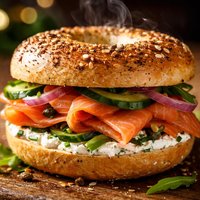
Bagel with Cream Cheese and Salmon

Elevate your breakfast or brunch game with this classic Bagel with Cream Cheese and Salmon recipe—an effortless yet elegant dish bursting with flavor and perfect for any occasion. Featuring toasted bagels slathered with creamy, tangy cream cheese and topped with velvety smoked salmon, this recipe is a delightful balance of textures and tastes. Accented with briny capers, thin slices of red onion, and a sprinkle of fresh dill, each bite is brightened by a splash of fresh lemon juice and a touch of black pepper. Ready in just 20 minutes, this quintessential deli-inspired creation makes an ideal quick meal for two, offering both sophistication and simplicity in every bite. Perfect for seafood lovers and brunch enthusiasts, this recipe is a must-try!

Smart Nutrition Tracking with SnapCalorie

Explore More
Recipe Information
Ingredients
- 2 whole Bagel
- 100 grams Cream cheese
- 100 grams Smoked salmon
- 2 tablespoons Capers
- 0.5 whole Red onion
- 1 tablespoon Dill
- 0.5 whole Lemon
- 0.5 teaspoon Black pepper
Instructions
Slice the bagels horizontally.
Toast the bagel halves in a toaster or under a broiler for about 3-4 minutes until golden brown.
Meanwhile, finely slice the red onion into thin rings.
Chop the fresh dill and set aside.
Once the bagels are toasted, spread a generous layer of cream cheese on each half.
Top the cream cheese with slices of smoked salmon, evenly distributing the salmon between the bagels.
Scatter the capers over the salmon.
Place the onion rings over the capers, as desired.
Sprinkle the chopped dill over the top of each bagel.
Squeeze a bit of fresh lemon juice over each bagel half to add freshness.
Season with freshly ground black pepper to taste.
Serve immediately and enjoy your delicious bagel with cream cheese and salmon.
Nutrition Facts
Calories |
531 | ||
|---|---|---|---|
% Daily Value* |
|||
| Total Fat | 22.9 g | 29% | |
| Saturated Fat | 11.0 g | 55% | |
| Polyunsaturated Fat | 1.0 g | ||
| Cholesterol | 76 mg | 25% | |
| Sodium | 1409 mg | 61% | |
| Total Carbohydrate | 55.6 g | 20% | |
| Dietary Fiber | 5.4 g | 19% | |
| Total Sugars | 9.0 g | ||
| Protein | 25.3 g | 51% | |
| Vitamin D | 7.0 mcg | 35% | |
| Calcium | 182 mg | 14% | |
| Iron | 3.9 mg | 22% | |
| Potassium | 476 mg | 10% | |
*The % Daily Value tells you how much a nutrient in a serving of food contributes to a daily diet. 2,000 calories a day is used for general nutrition advice.


