Whole30 Classic Basil Pesto Sauce
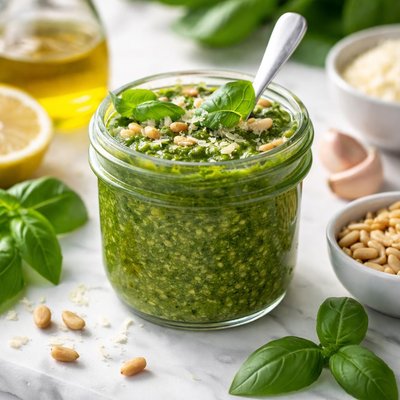
Bright, bold, and irresistibly fresh, this Whole30 Classic Basil Pesto Sauce reimagines the quintessential Italian favorite with a clean-eating twist. Packed with aromatic fresh basil, creamy toasted pine nuts, and zesty lemon juice, this dairy-free recipe gets its subtle cheesiness from nutritional yeast, making it perfect for those following Whole30 or paleo diets. Effortlessly blended in just 10 minutes, it’s rich, vibrant, and versatile—ideal as a topping for grilled meats, tossed with spiralized veggies, or even used as a dip for crunchy raw vegetables. With heart-healthy extra-virgin olive oil and a punch of garlic, this easy pesto sauce is a wholesome powerhouse of flavor that can be stored in the fridge for up to a week or frozen for future meals.

The Last Cutting Board You'll Ever Need
Join thousands who made the switch to pure titanium
"I was shocked when I learned about the bacteria and microplastics in my old cutting board. Switching to Titan Haus was the best decision—I'll never go back!"
Recipe Information
Ingredients
- 2 cups Fresh basil leaves
- 1 cup Pine nuts
- 3 large Garlic cloves
- 2 tablespoons Lemon juice
- 1 tablespoon Nutritional yeast
- 0.5 cup Extra-virgin olive oil
- 0.5 teaspoon Salt
- 0.25 teaspoon Freshly ground black pepper
Instructions
Start by washing and thoroughly drying 2 cups of fresh basil leaves. Remove any thick stems to ensure a smooth pesto consistency.
In a dry skillet over medium heat, toast 1 cup of pine nuts for about 3-4 minutes, shaking the pan occasionally, until they are golden brown and fragrant. Remove from heat and let them cool.
Peel and roughly chop 3 large garlic cloves.
In a food processor, combine the basil leaves, toasted pine nuts, garlic, 2 tablespoons of lemon juice, and 1 tablespoon of nutritional yeast.
Pulse the mixture until it forms a coarse paste.
With the food processor running, slowly drizzle in 0.5 cup of extra-virgin olive oil until the mixture is smooth and emulsified.
Scrape down the sides of the bowl and add 0.5 teaspoon of salt and 0.25 teaspoon of freshly ground black pepper. Pulse a few more times to combine.
Taste the pesto and adjust the seasoning if necessary with additional salt, pepper, or lemon juice.
Transfer the pesto to an airtight container and refrigerate. The pesto can be stored in the fridge for up to a week or frozen for longer storage.
Use this Whole30 basil pesto sauce as a fresh topping for grilled meats, tossed with spiralized vegetables, or as a dip for raw veggies.
Nutrition Facts
Calories |
255 | ||
|---|---|---|---|
% Daily Value* |
|||
| Total Fat | 26.4 g | 34% | |
| Saturated Fat | 2.9 g | 14% | |
| Polyunsaturated Fat | 5.7 g | ||
| Cholesterol | 0 mg | 0% | |
| Sodium | 123 mg | 5% | |
| Total Carbohydrate | 3.9 g | 1% | |
| Dietary Fiber | 1.4 g | 5% | |
| Total Sugars | 0.7 g | ||
| Protein | 3.3 g | 7% | |
| Vitamin D | 0.0 mcg | 0% | |
| Calcium | 27 mg | 2% | |
| Iron | 1.6 mg | 9% | |
| Potassium | 171 mg | 4% | |
*The % Daily Value tells you how much a nutrient in a serving of food contributes to a daily diet. 2,000 calories a day is used for general nutrition advice.



