Venison Salami
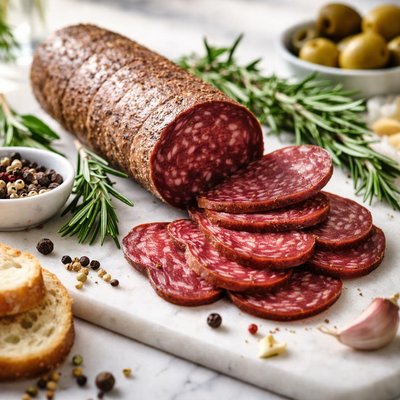
Elevate your charcuterie game with this rustic and flavorful Venison Salami recipe, a perfect blend of lean, protein-rich venison and buttery pork fatback. Seasoned with aromatic spices like garlic powder, fennel seeds, and a touch of smoky paprika, this artisan salami delivers a balanced medley of savory, spicy, and subtly sweet notes. Crafted using traditional curing methods with Cure #2 and slow-aged for 4-6 weeks, this recipe yields perfectly textured salami with a rich depth of flavor. Ideal for a charcuterie board, your next gourmet gathering, or as a hearty snack, this homemade venison delicacy offers an authentic taste of dry-cured perfection. Keywords: venison salami recipe, homemade salami, dry-cured meats, charcuterie board ideas, traditional curing techniques.

Smart Nutrition Tracking with SnapCalorie

Explore More
Recipe Information
Ingredients
- 1000 grams Venison (ground)
- 400 grams Pork fatback (ground)
- 25 grams Kosher salt
- 6 grams Cure #2 (curing salt with nitrates, for dry-cured meats)
- 5 grams Dextrose (or sugar)
- 5 grams Black pepper (ground)
- 4 grams Garlic powder
- 4 grams Paprika (sweet or smoked)
- 2 grams Fennel seeds (optional)
- 2 grams Red chili flakes (optional, for heat)
- 80 ml Ice water
- 1 package Natural hog casings
Instructions
1. Rinse the natural hog casings in cold water to remove excess salt and soak them in fresh water for at least 30 minutes. Set aside.
2. In a large mixing bowl, combine the ground venison and pork fatback. Mix well to distribute evenly.
3. Add the kosher salt, Cure #2, dextrose, black pepper, garlic powder, paprika, fennel seeds, and red chili flakes (if using). Mix thoroughly by hand or using a stand mixer until the mixture becomes sticky and cohesive.
4. Gradually add the ice water, mixing continuously to ensure it is absorbed evenly.
5. Prepare the sausage stuffer with a small nozzle attachment and slide the soaked casings onto the nozzle, leaving a couple of inches overhang to tie off.
6. Carefully feed the meat mixture into the stuffer, making sure the filling is compact and there are no air pockets. Twist each salami link to the desired length (typically 12-16 inches), leaving enough space to tie off each end with butcher's twine.
7. Prick any visible air pockets with a sterilized sausage needle or pin to allow air to escape and prevent imperfections during drying.
8. Weigh each salami, record the weight, and write it down. The salami will need to lose about 30-40% of its weight during the drying/curing process.
9. Hang the salami in a controlled environment with a temperature of 50-60°F (10-15°C) and a relative humidity of 75-80%. Ensure good airflow around each salami.
10. Allow the salami to cure for 4-6 weeks, checking periodically to ensure proper drying conditions are maintained. The salami is ready when it has lost 30-40% of its original weight.
11. Once cured, slice thinly and serve as part of a charcuterie board or as a snack. Store any unused salami in the refrigerator, or vacuum seal and freeze for longer storage.
Nutrition Facts
Calories |
580 | ||
|---|---|---|---|
% Daily Value* |
|||
| Total Fat | 52.2 g | 67% | |
| Saturated Fat | 19.8 g | 99% | |
| Polyunsaturated Fat | 0.0 g | ||
| Cholesterol | 135 mg | 45% | |
| Sodium | 1182 mg | 51% | |
| Total Carbohydrate | 1.8 g | 1% | |
| Dietary Fiber | 0.4 g | 1% | |
| Total Sugars | 0.5 g | ||
| Protein | 27.5 g | 55% | |
| Vitamin D | 0.0 mcg | 0% | |
| Calcium | 22 mg | 2% | |
| Iron | 3.9 mg | 22% | |
| Potassium | 374 mg | 8% | |
*The % Daily Value tells you how much a nutrient in a serving of food contributes to a daily diet. 2,000 calories a day is used for general nutrition advice.


