Vegan Khinkali
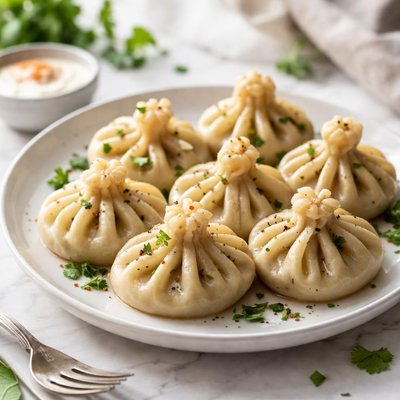
Vegan Khinkali is a plant-based twist on Georgia's beloved dumplings, combining tender handmade dough and a savory filling that's bursting with flavor. This recipe swaps the traditional meat for a hearty mix of brown lentils, button mushrooms, caramelized onions, and fresh parsley, expertly seasoned with cumin, coriander, and black pepper for a rich, aromatic profile. Skillfully pleated to create their signature look, these dumplings are simmered until they float to perfection, making them irresistibly tender and juicy. Perfect for a comforting dinner or an impressive dish to share, Vegan Khinkali offers an authentic taste of Georgian cuisine that's completely cruelty-free. Cook up this satisfying recipe to enjoy the perfect balance of tradition and innovation! Keywords: vegan khinkali recipe, Georgian dumplings, plant-based dumplings, lentil and mushroom filling, easy vegan dumplings.

Smart Nutrition Tracking with SnapCalorie

Explore More
Recipe Information
Ingredients
- 500 grams All-purpose flour
- 250 ml Warm water
- 1 teaspoon Salt
- 2 tablespoons Olive oil
- 150 grams Brown lentils
- 250 grams Button mushrooms
- 1 medium, finely chopped Onion
- 2 cloves, minced Garlic
- 1 teaspoon Ground black pepper
- 1 teaspoon, ground Coriander seeds
- 1 teaspoon, ground Cumin
- 15 grams, chopped Fresh parsley
- 1 liter Water
Instructions
Start by preparing the dough: in a large bowl, combine the flour and salt. Gradually add the warm water and olive oil, stirring with a fork until a dough forms.
Knead the dough on a floured surface for about 10 minutes until it is smooth and elastic. Cover with a towel and let it rest for 30 minutes.
While the dough is resting, prepare the filling. Cook the lentils in boiling water until they're tender but not mushy, about 15-20 minutes. Drain and set aside.
Finely chop the mushrooms and onion. In a large skillet, heat a tablespoon of olive oil over medium heat. Sauté the onions until translucent, about 5 minutes. Add the garlic and sauté for another minute.
Add the mushrooms to the skillet and cook until they release their moisture and become golden, about 7-10 minutes.
Add the cooked lentils, black pepper, ground coriander, cumin, and salt to taste. Cook for another 3 minutes to blend the flavors, then remove from heat. Stir in the chopped parsley and set aside.
Divide the rested dough into 20 equal pieces. Roll each piece into a thin circle, about 10cm in diameter.
Place about a tablespoon of the filling in the center of each dough circle.
Gather the edges of the dough around the filling, pleating and pinching as you go to form a tight seal at the top.
Bring the water to a boil in a large pot with an additional teaspoon of salt. Gently add the khinkali into the boiling water, being careful not to overcrowd the pot.
Cook the khinkali for about 10-12 minutes, until the dough is cooked and the khinkali float to the surface.
Use a slotted spoon to remove the khinkali and let them drain. Serve warm.
Nutrition Facts
Calories |
615 | ||
|---|---|---|---|
% Daily Value* |
|||
| Total Fat | 8.9 g | 11% | |
| Saturated Fat | 1.2 g | 6% | |
| Polyunsaturated Fat | 0.0 g | ||
| Cholesterol | 0 mg | 0% | |
| Sodium | 511 mg | 22% | |
| Total Carbohydrate | 113.5 g | 41% | |
| Dietary Fiber | 8.3 g | 30% | |
| Total Sugars | 4.2 g | ||
| Protein | 19.6 g | 39% | |
| Vitamin D | 0.1 mcg | 1% | |
| Calcium | 84 mg | 6% | |
| Iron | 7.7 mg | 43% | |
| Potassium | 566 mg | 12% | |
*The % Daily Value tells you how much a nutrient in a serving of food contributes to a daily diet. 2,000 calories a day is used for general nutrition advice.


