Tamagoyaki

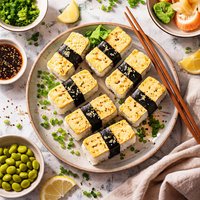
Brighten up your breakfast or bento box with **Tamagoyaki**, a traditional Japanese rolled omelette that’s as delicious as it is visually striking! Made with just a handful of simple ingredients—**eggs, dashi stock, soy sauce, mirin, and sugar**—this dish combines sweet and savory notes for a perfectly balanced flavor. The key to its signature layered texture lies in the careful folding technique, which is traditionally done using a rectangular tamagoyaki pan but can also be mastered with a non-stick skillet. Light, fluffy, and subtly sweet, this 15-minute recipe is perfect for quick meals, appetizers, or sushi fillings. Serve it warm or at room temperature for an authentic Japanese dining experience that’s sure to impress!

Smart Nutrition Tracking with SnapCalorie




Recipe Information
Ingredients
- 4 large eggs
- 2 tablespoons dashi stock
- 1 teaspoon soy sauce
- 1 tablespoon mirin
- 1 tablespoon sugar
- 1 tablespoon vegetable oil
Instructions
In a medium bowl, crack the eggs and whisk them until well combined.
Add dashi stock, soy sauce, mirin, and sugar to the eggs. Whisk together until the sugar is dissolved and all ingredients are well combined.
Heat a tamagoyaki pan (or a small non-stick skillet) over medium heat. Lightly oil the pan with a small amount of vegetable oil, ensuring even coverage.
Pour a thin layer of the egg mixture into the pan, just enough to cover the bottom. Tilt the pan to distribute the egg evenly.
As the edges of the egg go from liquid to solid, use a spatula or chopsticks to gently lift and fold the cooked egg towards the far end of the pan.
Add a little more oil if necessary, then pour more egg mixture into the pan, again covering the bottom. Lift the rolled-up egg so the uncooked egg can flow underneath it.
Once the new layer begins to set, roll the egg back towards you, incorporating the new layer into the roll.
Repeat the process, adding a little more oil as needed, until all the egg mixture is used and the omelette is fully rolled to the desired thickness.
Remove from the heat and let rest for a minute before transferring to a cutting board.
Slice the rolled omelette into bite-sized pieces and serve warm or at room temperature.
Nutrition Facts
Calories |
239 | ||
|---|---|---|---|
% Daily Value* |
|||
| Total Fat | 16.2 g | 21% | |
| Saturated Fat | 4.2 g | 21% | |
| Polyunsaturated Fat | 4.2 g | ||
| Cholesterol | 372 mg | 124% | |
| Sodium | 289 mg | 13% | |
| Total Carbohydrate | 9.8 g | 4% | |
| Dietary Fiber | 0.0 g | 0% | |
| Total Sugars | 8.2 g | ||
| Protein | 13.0 g | 26% | |
| Vitamin D | 2.1 mcg | 10% | |
| Calcium | 58 mg | 4% | |
| Iron | 1.8 mg | 10% | |
| Potassium | 149 mg | 3% | |
*The % Daily Value tells you how much a nutrient in a serving of food contributes to a daily diet. 2,000 calories a day is used for general nutrition advice.


