Spooky Eyeballs
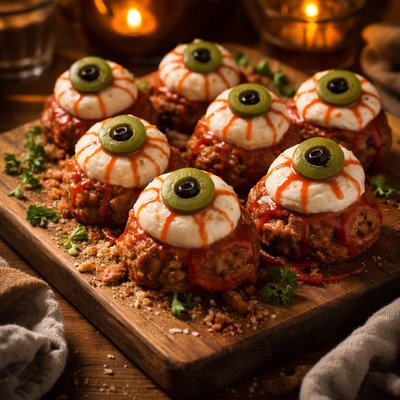
Get ready to spook and delight your guests with these easy and eerily realistic Spooky Eyeballs, the perfect addition to your Halloween party spread! Crafted with white chocolate candies as the base, each eyeball features a mini chocolate chip pupil surrounded by a colorful gel icing iris for an uncanny realism. Red gel icing adds bloodshot details, creating a gory yet fun look that’s sure to grab attention. This no-bake recipe requires just 15 minutes of prep time and uses a simple powdered sugar glaze to hold it all together. Perfect for kids’ parties or haunted gatherings, these edible Halloween treats are as creepy as they are delicious—startle your guests and satisfy their sweet tooth in one delightful bite!

Smart Nutrition Tracking with SnapCalorie

Recipe Information
Ingredients
- 12 pieces White chocolate candies (like white chocolate truffles or white chocolate-covered cherries)
- 12 pieces Mini chocolate chips
- 1 tube Red gel icing
- 1 tube Blue or green gel icing
- 2 tablespoons Powdered sugar
- 1 teaspoon Water
Instructions
Prepare a simple icing glue by mixing powdered sugar and water in a small bowl until it forms a thick paste. Set aside for later use.
Take each white chocolate candy and inspect it for a round, smooth surface that will act as the base for your spooky eyeball.
Using a small drop of the icing glue, attach one mini chocolate chip (pointy side down) to the surface of each candy to resemble the dark center (pupil) of the eye.
Apply a small circle of blue or green gel icing around the mini chocolate chip to form the iris of the eyeball.
Use the red gel icing to draw thin, squiggly lines radiating outward from the edges of the candy to mimic blood vessels, creating a creepy bloodshot effect.
Allow the eyeballs to sit for 10 minutes so the icing glue can set and hold everything in place.
Once set, gently arrange your spooky eyeballs on a serving platter and present them at your Halloween gathering!
Nutrition Facts
Calories |
110 | ||
|---|---|---|---|
% Daily Value* |
|||
| Total Fat | 4.0 g | 5% | |
| Saturated Fat | 2.4 g | 12% | |
| Polyunsaturated Fat | 0.0 g | ||
| Cholesterol | 3 mg | 1% | |
| Sodium | 11 mg | 0% | |
| Total Carbohydrate | 18.3 g | 7% | |
| Dietary Fiber | 0.0 g | 0% | |
| Total Sugars | 17.1 g | ||
| Protein | 0.6 g | 1% | |
| Vitamin D | 0.0 mcg | 0% | |
| Calcium | 18 mg | 1% | |
| Iron | 0.0 mg | 0% | |
| Potassium | 16 mg | 0% | |
*The % Daily Value tells you how much a nutrient in a serving of food contributes to a daily diet. 2,000 calories a day is used for general nutrition advice.


