Sourdough Bread and Starter
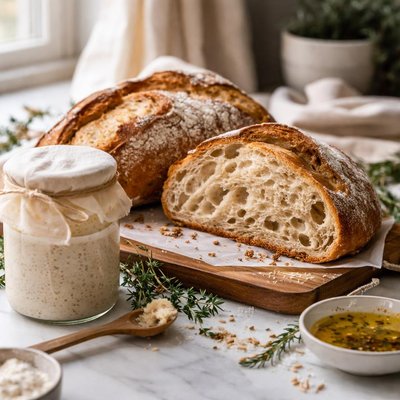
Master the art of traditional sourdough bread baking with this comprehensive "Sourdough Bread and Starter" recipe. Perfect for beginners and seasoned bakers alike, this step-by-step guide takes you through the rewarding process of creating your own bubbly, tangy sourdough starter from scratch, followed by crafting a beautifully crusty loaf of bread with a soft, airy crumb. Featuring a hands-on approach with techniques like stretch-and-folds and cold proofing, this recipe elevates your baking skills while delivering that signature sourdough flavor. Baked in a Dutch oven for bakery-quality results, this loaf pairs perfectly with everything from creamy butter to hearty soups. Let the slow fermentation process transform simple pantry staples into a masterpiece you'll savor slice after slice.

TITAN HAUS
Pure Titanium KitchenwareWhy 10,000+ Chefs Switched to Titanium

Recipe Information
Ingredients
- 120 grams All-purpose flour (for starter)
- 120 grams Water (for starter)
- 500 grams All-purpose flour (for bread)
- 350 grams Water (for bread)
- 10 grams Salt
- 100 grams Sourdough starter
Instructions
Day 1: In a clean glass jar or bowl, mix 120 grams of all-purpose flour with 120 grams of water. Stir well to combine, ensuring no dry patches of flour remain. Cover loosely with a lid or clean cloth, and let it sit at room temperature for 24 hours.
Day 2: After 24 hours, check your mixture. It may or may not exhibit a few bubbles, which is normal. Discard half of the starter (about 120 grams) and feed it with another 120 grams of all-purpose flour and 120 grams of water. Stir well and let it sit at room temperature, loosely covered, for another 24 hours.
Day 3-6: Repeat the Day 2 process every 24 hours. By Day 5 or 6, your starter should be bubbly and have a pleasant, tangy smell. It is now ready to use.
Day 7: To make the bread, in a large mixing bowl, combine 500 grams of all-purpose flour with 350 grams of water. Mix into a rough dough, cover, and let it rest for 30 minutes (autolyse phase).
After 30 minutes, add 100 grams of active sourdough starter and 10 grams of salt to the dough. Mix well until the starter and salt are fully incorporated. You can use your hands to knead briefly or a stand mixer with a dough hook.
Cover the dough with a damp towel or plastic wrap and let it undergo bulk fermentation at room temperature for 4-6 hours. During this time, perform 3-4 sets of stretch-and-folds every 30 minutes during the first 2 hours.
Once bulk fermentation is complete and the dough has doubled in size, turn it out onto a lightly floured surface. Shape the dough into a round or oval loaf, depending on your preference. Place it into a floured banneton or bowl lined with a kitchen towel. Cover and refrigerate overnight for a cold proof.
The next day, preheat your oven to 475°F (245°C) with a Dutch oven inside for at least 30 minutes. Carefully invert the proofed dough onto a piece of parchment paper and score the top with a sharp knife or bread lame.
Carefully transfer the dough (on the parchment paper) into the hot Dutch oven. Cover with the lid and bake for 20 minutes. Then, remove the lid and bake for another 20 minutes to develop a golden, crunchy crust.
Remove the bread from the oven and let it cool completely on a wire rack before slicing. Enjoy your homemade sourdough bread!
Nutrition Facts
Calories |
288 | ||
|---|---|---|---|
% Daily Value* |
|||
| Total Fat | 0.8 g | 1% | |
| Saturated Fat | 0.1 g | 1% | |
| Polyunsaturated Fat | 0.0 g | ||
| Cholesterol | 0 mg | 0% | |
| Sodium | 488 mg | 21% | |
| Total Carbohydrate | 60.5 g | 22% | |
| Dietary Fiber | 2.1 g | 8% | |
| Total Sugars | 0.1 g | ||
| Protein | 8.2 g | 16% | |
| Vitamin D | 0.0 mcg | 0% | |
| Calcium | 13 mg | 1% | |
| Iron | 3.5 mg | 19% | |
| Potassium | 89 mg | 2% | |
*The % Daily Value tells you how much a nutrient in a serving of food contributes to a daily diet. 2,000 calories a day is used for general nutrition advice.



