Soft Sourdough Bread
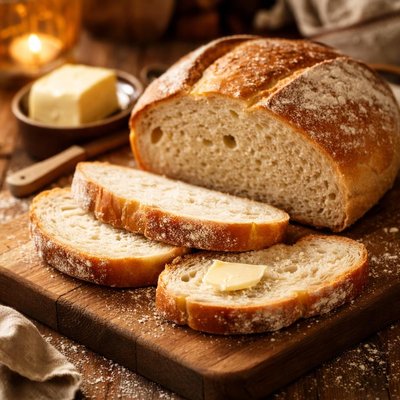
Perfect your bread-baking skills with this Soft Sourdough Bread recipe, a delightful fusion of airy texture and tangy flavor. Made with a few simple ingredients—active sourdough starter, bread flour, warm water, salt, and a touch of olive oil—this recipe yields a soft, golden crust and a pillowy interior that’s perfect for sandwiches, toast, or enjoying on its own. The process highlights traditional techniques like the autolyse method, stretch-and-folds, and an overnight cold fermentation, ensuring a bread that’s both elastic and flavorful. With detailed steps to guide you through every rise and fold, this recipe is approachable for beginners while offering the depth and nuance that seasoned bakers crave. Bake it in a Dutch oven or on a baking tray and savor the irresistible aroma of homemade sourdough.

Smart Nutrition Tracking with SnapCalorie



Recipe Information
Ingredients
- 100 grams Active sourdough starter
- 350 grams Warm water
- 500 grams Bread flour
- 10 grams Salt
- 15 grams Olive oil
Instructions
In a large mixing bowl, combine the sourdough starter and warm water. Stir until the starter dissolves.
Add the bread flour to the bowl and mix until a shaggy dough forms. Cover the bowl and let it rest for 30 minutes (autolyse process).
Sprinkle the salt over the dough and drizzle in the olive oil. Use your hands to knead the dough in the bowl until the salt and oil are fully incorporated, about 5 minutes.
Transfer the dough to a clean surface and perform a series of stretch-and-folds: grab one edge of the dough, stretch it upwards, then fold it over the rest of the dough. Turn the dough 90 degrees and repeat. Perform this process 4 to 6 times, then rest the dough for 30 minutes.
Over the next 2 hours, perform stretch-and-folds every 30 minutes. This helps build structure and elasticity in the dough.
After the last stretch-and-fold, let the dough ferment at room temperature for 4 to 6 hours, or until it has doubled in size.
Gently turn the dough out onto a lightly floured surface. Shape it into a ball or loaf, being careful not to deflate it. Place the shaped dough into a floured proofing basket or loaf pan.
Cover the dough and let it proof in the refrigerator overnight (8 to 12 hours).
The next day, preheat your oven to 220°C (425°F). If using a Dutch oven, place it in the oven while it preheats.
Score the top of the dough with a sharp knife or bread lame. If using a Dutch oven, carefully transfer the dough into it. If baking on a tray, place the dough directly on the prepared tray.
Bake the bread for 20 minutes with the Dutch oven lid on or with a pan of water in the oven to create steam. Then, reduce the oven temperature to 190°C (375°F) and bake for another 15 to 20 minutes, or until the bread is golden brown and sounds hollow when tapped.
Remove the bread from the oven and let it cool completely on a wire rack before slicing.
Nutrition Facts
Calories |
167 | ||
|---|---|---|---|
% Daily Value* |
|||
| Total Fat | 1.7 g | 2% | |
| Saturated Fat | 0.2 g | 1% | |
| Polyunsaturated Fat | 0.0 g | ||
| Cholesterol | 0 mg | 0% | |
| Sodium | 325 mg | 14% | |
| Total Carbohydrate | 32.7 g | 12% | |
| Dietary Fiber | 1.2 g | 4% | |
| Total Sugars | 0.2 g | ||
| Protein | 4.4 g | 9% | |
| Vitamin D | 0.0 mcg | 0% | |
| Calcium | 8 mg | 1% | |
| Iron | 1.9 mg | 10% | |
| Potassium | 43 mg | 1% | |
*The % Daily Value tells you how much a nutrient in a serving of food contributes to a daily diet. 2,000 calories a day is used for general nutrition advice.


