Quick and Easy Pickled Onions
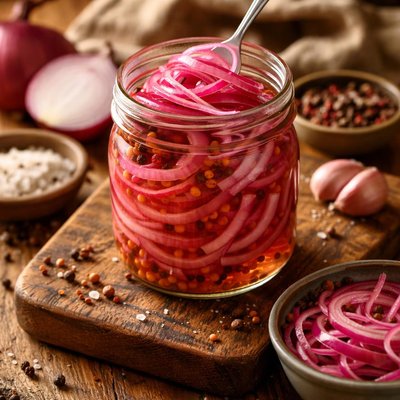
Transform your meals with these vibrant, zesty *Quick and Easy Pickled Onions*—an irresistible condiment that’s ready in just minutes! Made with crisp red onions, tangy white vinegar, and a hint of sweetness from sugar, these pickles are elevated with aromatic garlic, black peppercorns, and a bay leaf for a subtle herbal note. Perfectly balanced with salty and savory flavors, this no-fuss recipe requires only 10 minutes of prep and minimal cooking. Use these versatile pickled onions to brighten up tacos, sandwiches, salads, or burgers. With their stunning pink hue and bold, punchy taste, these refrigerator pickles are as beautiful as they are delicious. Ready to enjoy in less than an hour, they’re a staple every home cook needs to try!

Smart Nutrition Tracking with SnapCalorie

Recipe Information
Ingredients
- 2 medium red onions
- 1 cup white vinegar
- 1 cup water
- 2 tablespoons sugar
- 1.5 teaspoons salt
- 5 whole black peppercorns
- 2 cloves garlic cloves
- 1 whole bay leaf
Instructions
Peel and thinly slice the red onions and place them in a clean, heatproof jar or container.
In a small saucepan, combine the white vinegar, water, sugar, and salt.
Add the black peppercorns, peeled and crushed garlic cloves, and the bay leaf to the vinegar mixture.
Heat the mixture over medium heat until the sugar and salt are fully dissolved. Bring it to just a boil and then remove from heat.
Carefully pour the hot vinegar mixture over the sliced onions in the jar until they are fully submerged.
Allow the jar to cool to room temperature, then cover with a lid and refrigerate the pickled onions.
Let the onions pickle for at least 30 minutes before serving. For best results, refrigerate for several hours or overnight.
The pickled onions can be stored in the refrigerator for up to 2 weeks.
Nutrition Facts
Calories |
25 | ||
|---|---|---|---|
% Daily Value* |
|||
| Total Fat | 0.0 g | 0% | |
| Saturated Fat | 0.0 g | 0% | |
| Polyunsaturated Fat | 0.0 g | ||
| Cholesterol | 0 mg | 0% | |
| Sodium | 366 mg | 16% | |
| Total Carbohydrate | 6.2 g | 2% | |
| Dietary Fiber | 0.6 g | 2% | |
| Total Sugars | 4.3 g | ||
| Protein | 0.4 g | 1% | |
| Vitamin D | 0.0 mcg | 0% | |
| Calcium | 13 mg | 1% | |
| Iron | 0.1 mg | 1% | |
| Potassium | 48 mg | 1% | |
*The % Daily Value tells you how much a nutrient in a serving of food contributes to a daily diet. 2,000 calories a day is used for general nutrition advice.


