Low Sodium Spicy Tuna Sandwich
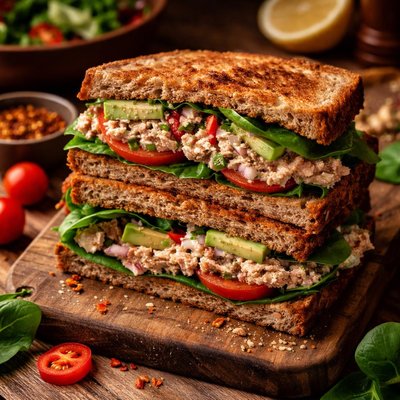
Elevate your lunchtime routine with this flavorful Low Sodium Spicy Tuna Sandwich, a heart-healthy twist on a classic favorite! This recipe combines no-salt-added canned tuna with low-sodium mayonnaise and tangy plain Greek yogurt for a creamy, protein-packed base. A kick of sriracha and Dijon mustard introduces bold, spicy notes, while fresh celery, red onion, parsley, and a hint of lemon juice bring vibrant texture and zest. Served on whole wheat bread with crisp romaine lettuce and juicy tomato slices, this sandwich offers a satisfying crunch and freshness with every bite. Perfectly crafted for those watching their sodium intake, yet bursting with taste, it’s ready in just 15 minutes—ideal for a quick and wholesome meal.

Smart Nutrition Tracking with SnapCalorie


Recipe Information
Ingredients
- 2 cans No-salt-added canned tuna (drained)
- 2 tablespoons Low-sodium mayonnaise
- 2 tablespoons Plain Greek yogurt
- 1 teaspoon Dijon mustard
- 1 teaspoon Sriracha sauce (or your preferred hot sauce)
- 1 stalk Celery (finely diced)
- 2 tablespoons Red onion (finely diced)
- 1 tablespoon Fresh parsley (chopped)
- 1 teaspoon Lemon juice (freshly squeezed)
- 1 pinch Ground black pepper
- 4 slices Whole wheat bread (low-sodium option)
- 2 leaves Romaine lettuce leaves
- 4 slices Tomato slices
Instructions
Drain the no-salt-added canned tuna thoroughly and place it in a medium mixing bowl.
Add the low-sodium mayonnaise, Greek yogurt, Dijon mustard, and sriracha sauce to the bowl.
Mix the tuna and condiments until well combined and smooth.
Stir in the finely diced celery, red onion, and chopped parsley for texture and flavor.
Add the freshly squeezed lemon juice and ground black pepper. Mix again to evenly distribute the flavors.
Toast the slices of whole wheat bread for extra crunch, if desired.
On two slices of toast, place a romaine lettuce leaf and two slices of tomato each.
Divide the tuna mixture evenly and pile it onto the prepared bread slices with the tomato and lettuce.
Top each sandwich with the remaining slices of toast, slice in half, and serve immediately.
Nutrition Facts
Calories |
448 | ||
|---|---|---|---|
% Daily Value* |
|||
| Total Fat | 9.9 g | 13% | |
| Saturated Fat | 1.4 g | 7% | |
| Polyunsaturated Fat | 0.0 g | ||
| Cholesterol | 48 mg | 16% | |
| Sodium | 341 mg | 15% | |
| Total Carbohydrate | 46.0 g | 17% | |
| Dietary Fiber | 7.9 g | 28% | |
| Total Sugars | 7.5 g | ||
| Protein | 43.9 g | 88% | |
| Vitamin D | 2.4 mcg | 12% | |
| Calcium | 135 mg | 10% | |
| Iron | 3.4 mg | 19% | |
| Potassium | 698 mg | 15% | |
*The % Daily Value tells you how much a nutrient in a serving of food contributes to a daily diet. 2,000 calories a day is used for general nutrition advice.


