
Low Sodium Classic Sourdough Bread
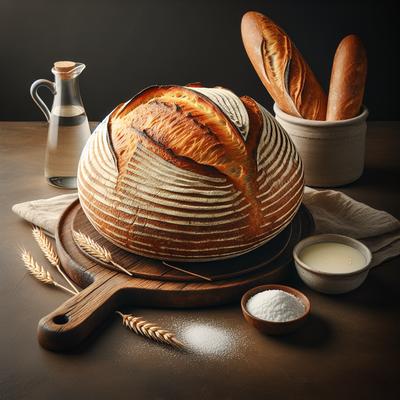
Indulge in the timeless art of breadmaking with this Low Sodium Classic Sourdough Bread, a healthier twist on a beloved tradition. Made with just four simple ingredients—flour, water, an active sourdough starter, and a pinch of salt—this recipe is perfect for those looking to reduce their sodium intake without sacrificing flavor. The long fermentation process, including an overnight proof in the refrigerator, enhances the bread’s tangy sourdough notes while delivering a soft, airy crumb and a satisfying golden crust. Utilizing techniques like autolyse and stretch-and-fold ensures excellent gluten development, resulting in bakery-quality bread right from your oven. Baked to perfection in a Dutch oven, this low-sodium sourdough is ideal for any occasion, whether served as a standalone treat or paired with your favorite soups and spreads. It's a wholesome, artisan delight that’s as rewarding to bake as it is to savor!

Log this recipe in SnapCalorie

Recipe Information
Ingredients
- 500 grams All-purpose flour
- 350 ml Water
- 100 grams Active sourdough starter
- 3 grams Salt
Instructions
In a large mixing bowl, combine 500 grams of all-purpose flour with 350 ml of water. Mix until no dry flour remains, then cover and let sit for about 30 minutes to perform autolyse, which helps with gluten development.
After 30 minutes, add 100 grams of active sourdough starter and 3 grams of salt to the mixture.
Mix the dough by hand, squeezing and folding until the salt and starter are incorporated evenly. Continue to knead until the dough starts to become smooth and elastic.
Cover the bowl with a damp cloth and let the dough rest at room temperature for about 4 hours, performing stretch and folds every 30 minutes for the first 2 hours. To perform a stretch and fold, wet your hands, grab the edge of the dough, stretch it up and fold it over itself. Rotate the bowl a quarter turn and repeat 3 more times.
After the bulk fermentation, turn the dough out onto a lightly floured surface. Shape it into a round by gently pulling the edges to the center, then flip the dough over and use your hands to create surface tension by dragging the dough slightly against the work surface.
Place the shaped dough into a proofing basket lined with a floured cloth. Cover and let it proof in the refrigerator for 12 to 24 hours. This slow proofing develops the sourdough flavor.
Preheat your oven to 475°F (245°C) with a Dutch oven inside. This will take about 30 minutes.
Carefully remove the hot Dutch oven from the oven. Gently turn the proofed dough out onto a piece of parchment paper. Using a sharp knife or razor blade, score the top of the dough with slashes. This allows the bread to expand properly.
Transfer the scored dough into the preheated Dutch oven, cover it, and bake for 20 minutes.
Remove the lid and bake for an additional 25 minutes or until the bread is a deep golden brown and sounds hollow when tapped on the bottom.
Allow the bread to cool on a wire rack for at least 1 hour before slicing to let the interior set properly.
Enjoy your delicious, low-sodium sourdough bread with your favorite toppings or as a side to your meal!
Nutrition Facts
Calories |
1870 | ||
|---|---|---|---|
% Daily Value* |
|||
| Total Fat | 5.4 g | 7% | |
| Saturated Fat | 0.9 g | 4% | |
| Polyunsaturated Fat | 0.0 g | ||
| Cholesterol | 0 mg | 0% | |
| Sodium | 1200 mg | 52% | |
| Total Carbohydrate | 391.6 g | 142% | |
| Dietary Fiber | 14.6 g | 52% | |
| Total Sugars | 1.1 g | ||
| Protein | 52.6 g | 105% | |
| Vitamin D | 0.0 mcg | 0% | |
| Calcium | 94 mg | 7% | |
| Iron | 23.7 mg | 132% | |
| Potassium | 556 mg | 12% | |
*The % Daily Value tells you how much a nutrient in a serving of food contributes to a daily diet. 2,000 calories a day is used for general nutrition advice.


